


- December 1, 2025
Ustad Shahid Parvez Khan’s music is powered by his passion for music

Shahid Parvez lets his music to speak for him.
| Photo Credit: Special Arrangement
Ustad Shahid Parvez Khan had his audience totally hooked at his recent concert in Delhi. In the audience was Ustad Amjad Ali Khan, his senior by a decade. This concert was different — from an incredibly precise five-note ‘meends’ and fast ‘taans,’ to elegant ‘gamaks’, ‘jhala’ played in the beenkaar ang’, and complex ‘layakaari’ — it had them all.
Belonging to the seventh generation of the famed Imdadkhani gharana of sitariyas., Shahid Parvez did not have it easy. He was initiated into music by his father Aziz Khan, who could not make a mark as a musician. However, Shahid Parvez’s grandfather Ustad Wahid Khan was a noted musician, but was overshadowed by his more feted, older brother Ustad Inayat Khan.
In an interview a few years ago, the sitar exponent had shared how as a young boy he was told to play both for himself and his father. Apart from this, when he emerged on stage in the early 1970s, he had to compete with sitarists from his own family such as Ustad Vilayat Khan, Ustad Imrat Khan and Ustad Rais Khan. Then there were also other greats such as Pt. Ravi Shankar, Pt. Nikhil Bannerji and Ustad Abdul Halim Jaffer Khan. While cousins Shujaat Khan, Nishat Khan and Irshad Khan had their fathers promoting them, Shahid Parvez had no such support. He gradually made a mark with dedicated ‘riyaaz’.
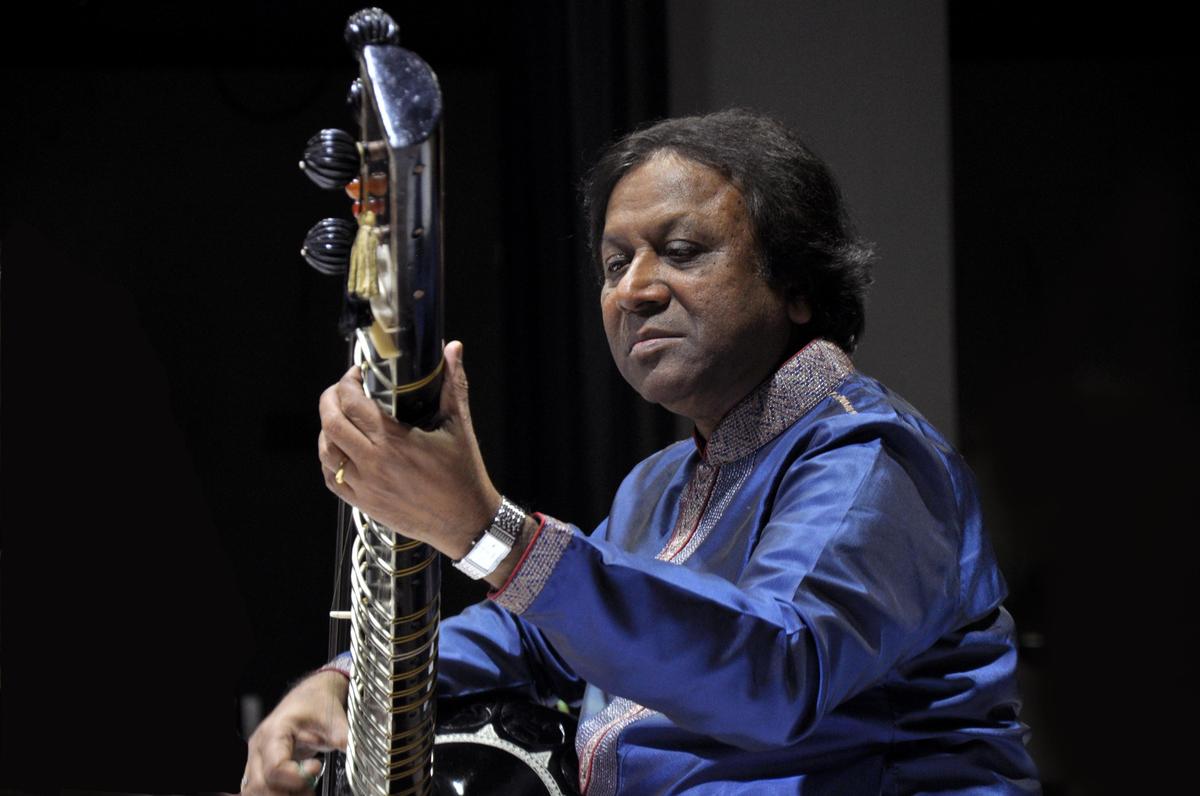
The complacency of mastery has no place on stage for the sitarist.
| Photo Credit:
Special Arrangement
At one of his first major concerts (in Delhi in the early 1970s), his father was on the stage with him, and, at one point during the concert, his father subtly indicated something to his teenage son. Shahid Parvez let fly a staggeringly fast and clear ‘sapaat taan’, covering three octaves, that had the audience in awe. But, he did not repeat this ‘taan’ again, despite his mastery. The knowledge of when to perform what and for what duration, remains one of Shahid Parvez’s most laudable attributes.
Another carefully thought out performance-strategy, of him, is not to repeat what others had performed before. He deliberately did not perform the traditional compositions of his illustrious family, and himself composed simpler easily absorbed compositions. The family usually preferred performing in ‘teentaal’. Shahid Parvez is more into ‘rupak’ and ‘jhaptaal’ compositions. He created his own style over the decades; one that is today, emulated by scores of sitarists.
An older generation of listeners rues the lack of ‘bolkaari’ in sitariyas of today; artistes such as Shahid Parvez have converted this too into an asset rather than a lack. The fluidity of the music is not broken up by heavy stroke-work.
What Shahid Parve’z concert proved was, even an artiste, the stature of an ‘Ustad’ needs to prove himself sometimes; the complacency of mastery has no place on stage. He needs to delve deep into his music to bring forth an artistically perfect presentation; despite having performed it thousands of times before.
Published – December 01, 2025 01:29 pm IST


