- June 10, 2026
Revisiting Sivan Brothers’ Kandapuranam songs

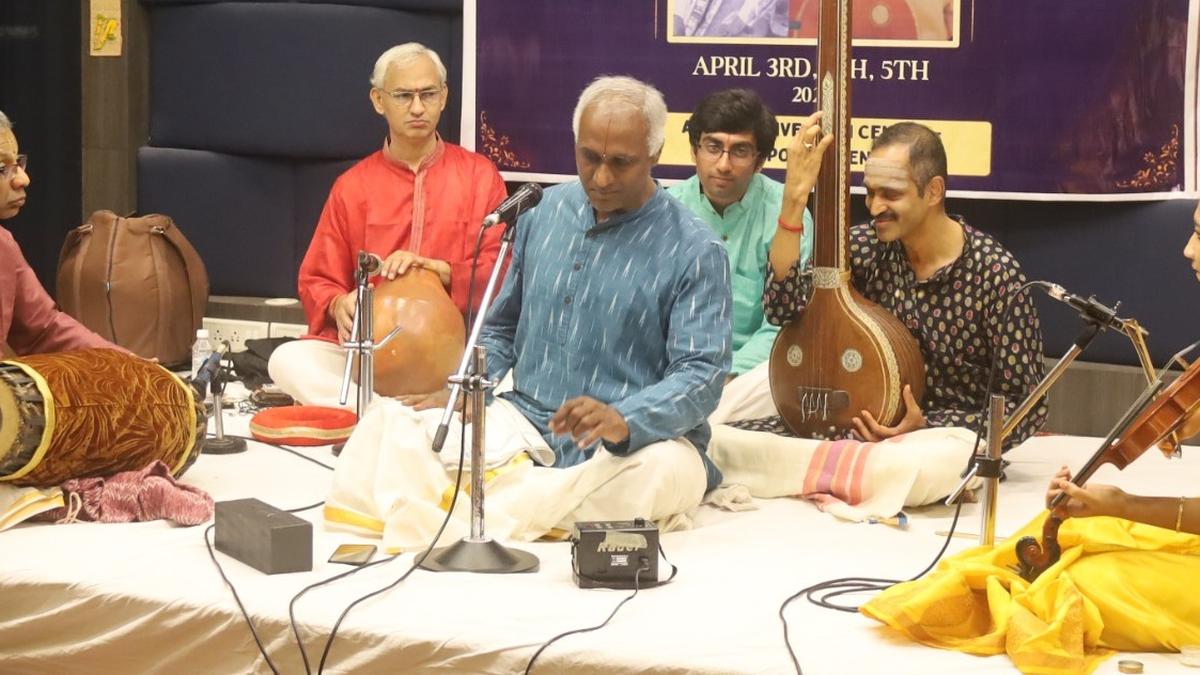
Vidya Kalyanaraman, Bhavya Hari and Brindha Manickavasakan performing at the 182nd jayanti of Maha Vaidyanatha Sivan, organised by Sri Guhadasa Trust. Their concert was themed on Kandapuranam kritis composed by the Sivan Brothers.
| Photo Credit: M. Srinath
Among the many compositional legacies rescued from the margins of music history are the kritis by Brahmasri Ramaswami Sivan and his brother that are concise versions of Kacchiyappa Sivacharya’s Kandapuranam verses. The Sivan Brothers, who lived and composed in the 19th century, were musicians of exceptional learning. Fluent in Tamil, Sanskrit and Telugu, they were also renowned for their literary scholarship. Both adopted ‘Guhadasa’ as their mudra, composing extensively across devotional and literary themes. Only a small portion of the kritis, one of the most significant works of the Sivan Brothers, survive — with around 40 of them published by Annamalai University.
These forty songs formed the basis of the Sri Guhadasa Trust’s thematic concert series, presented annually in honour of Maha Vaidyanatha Sivan. A five-part session that began at the 178th jayanti, concluded at the 182nd celebrated recently at the Arkay Convention Centre. On the occasion, the final seven kritis were performed by Bhavya Hari, Vidya Kalyanaraman and Brindha Manickavasakan, who were accompanied by Ananthakrishnan on the violin, Guru Ragavendra on the mridangam and Trichy K. Murali on the ghatam.

Vidya, Bhavya and Brindha accompanied by Ananthakrishnan on the violin, Guru Ragavendra on the mridangam and Trichy K. Murali on the ghatam.
| Photo Credit:
M. Srinath
The programme began with two songs outside of the Kandapuranam series composed by the Sivan Brothers. Brindha sang ‘Athi mugathavan padam’in raga Janaranjani, set to Adi tisra gathi, composed by Venkatraman belonging to the lineage of the Sivan Brothers. This was preceded by Kacchiyappa Sivacharya’s Kandapuranam cheyyul virutham ‘Mann ulaginil’. In fact, all the virtham rendered by the vocalists were Sivacharya’s compositions. Bhavya Hari followed with phalasruti virutham ‘En nayagan’ in Bilahari, leading into ‘Mal maruganai ninaindiru’, a Mel kala thani paadal, composed by Ramaswamy Sivan.
Then began the Kandapuranam kritis. The first, sung by Vidya was ‘’Indha porutkalukul’, introduced by the virutham ‘Aadai thol’moving between ragas such as Anandabhairavi and Mohanam for its two halves. The virutham described how Shiva, disguised as an old man, teasingly lists his own supposed inadequacies to test Parvathi’s resolve to marry him — from his graveyard abode and tiger-skin attire to erukku and umathai flowers, skulls, bones, snakes, poison, and an army of bhoothams — carried a literary precision that found an equal in the kriti that followed, whose clarity of meaning matched its beauty of expression. The violin traced a full arc across both ragas, and the three vocalists sang the kalpanaswaras together.
Brindha then sang ‘Avatharithare’ in Surutti and Chapu tala, a virutham from the Asura Kandam in which the devaguru bows to Tiruchendur Muruga and narrates the origins of the asuras, preceded by the virutham ‘Thandayum madanai’;the subsequent virutham by Bhavya, from the Yuddha Kandam — ‘Pannugindradhu en’split between Purvikalyani and Khamas, with the violin playing one phrase in each raga, it seamlessly led to the kriti, ‘Un karuthedhu sollada’in Khamas was also sung by Bhavya.
Vidya followed it up with the virutham ‘Pudayura vananginar’ in Varali, from the Deva Kandam, followed by the kriti, ‘Indraniyum vandhu’in Shankarabaranam — its pretext goes by, when Indra was pleased and happy at Muruga’s victory, Indra decides to offer his daughter Devayanai in marriage to Muruga at Tiruparankundram, he sends a messenger to call Indrani, his wife along with their daughter. Then Indrani along with Devayanai arrives on Airavata from Mount Meru to the temple town.
The Daksha Kandam formed the core of the thematic presentation. Here, the devaguru narrated the story of Daksha to Jayantha, Indra’s son; Brindha sang the virutham, ‘Enbu neerodu kazhiyodu’ in Hamir Kalyani and Dhanyasi — the violin remarkable throughout— before the kriti ‘Igazhchiyo pugazhchiyo’, its kalpanaswaras sung in ‘Magizhchiyai marai’, all three vocalists performing a neat full circle. The tani avartanam that followed was precise — bold mridangam strokes, the ghatam and mridangam interweaving cleanly end to end, the small chatusram-tisram mix in the mohara provided a moment of excitement.
Bhavya moved on to Valli Ammai avatharam segment of the concert with the virutham ‘Emathin vadivam sarndha’ followed by the kriti, ‘Mogham niraindhane’ in Abhogi. The concluding kriti of the series was rendered Vidya, who opened with the ‘Mullai kuravar’virutham in Sahana before taking up the kriti, ‘Tirumagal valarndale’. With the Maha Vaidyanatha Sivan mangalam, composed by Swetha (belonging to the Sivan Brothers’ lineage), the five-year series came to a close.
Published – June 10, 2026 04:46 pm IST