


- January 16, 2026
Andhra’s ‘High-Tech Doctor’ Zaps Potholes, Goes Viral With ‘Only Babu I Like’ Shoutout To CM — How ‘Road Hero’ Works
Last Updated:
‘The Road Doctor’ can detect and repair potholes within minutes. It is India’s first-of-its-kind mechanised pothole repair system.



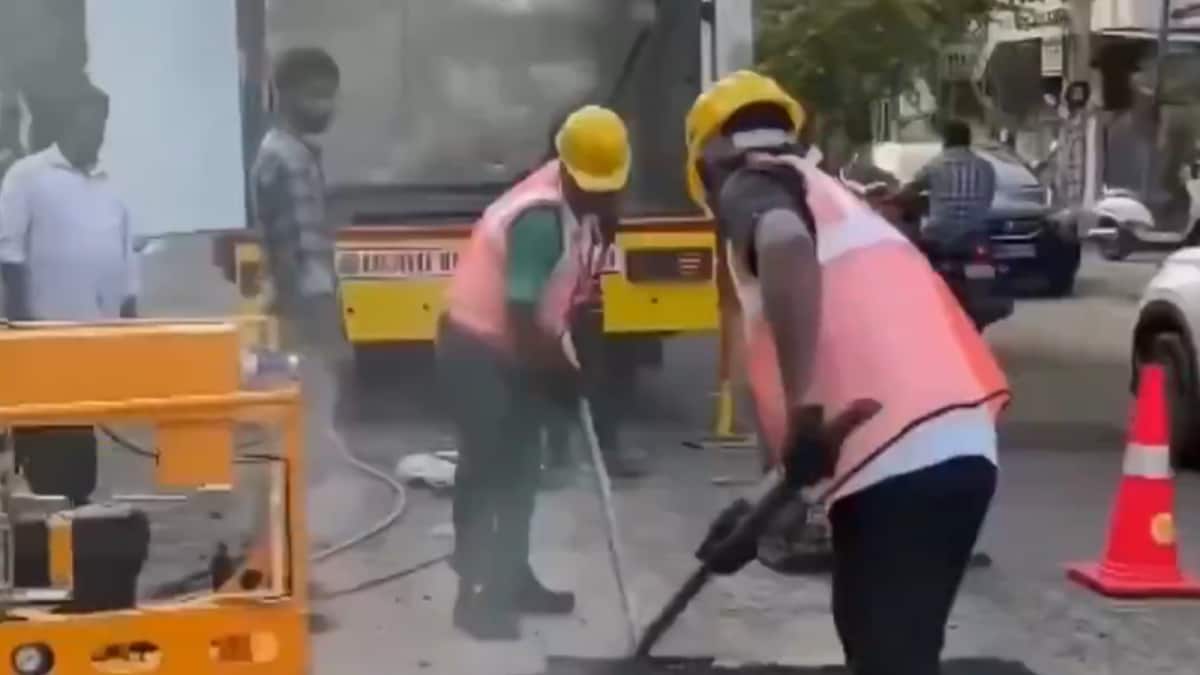
The Road Doctor moving from one pothole to another with precision.(Photo Credit: X)
Commuters in India face a constant challenge: Potholes. Not only do they cause traffic delays but are also dangerous. In a bid to tackle this persisting problem, Kakinada city in Andhra Pradesh has rolled out a tech-driven solution: a specialised pothole-repairing vehicle popularly called the “Road Doctor.”
The innovative vehicle can reportedly detect and repair potholes within minutes. A video shared on X (formerly Twitter) shows the machine in action which has left viewers impressed with its speed and efficiency.
Andhra Pradesh’s ‘Road Doctor’ In Action
The clip captures the Road Doctor at work. It moves from one pothole to another with precision. A carrier van is seen stationed mid-road as workers unload the compact machine, which heats, fill,s and levels damaged road stretches almost instantly. According to Odisha TV, quoting Kakinada Municipal Corporation, ‘The Road Doctor’ is India’s first-of-its-kind mechanised pothole repair system.
Watch The Clip Here
Internet Praise The Initiative
The Road Doctor has caught the attention of people across the country with social media users praising the innovation and its potential impact on road safety and maintenance. Here’s what some of them had to say:
One user commented, “What starts in Andhra Pradesh is now inspiring the nation. Citizens across India are calling for ‘Road Doctor’–like solutions, showcasing the impact of CM N. Chandrababu Naidu’s forward-thinking governance.”
What starts in Andhra Pradesh is now inspiring the nation.Citizens across India are calling for ‘Road Doctor’–like solutions, showcasing the impact of CM N. Chandrababu Naidu’s forward-thinking governance https://t.co/GpVQ7GSayU
— I Love India✌ (@Iloveindia_007) January 15, 2026
Another added, “This road doctor machine can save massive costs. Around 100 potholes can be repaired for Rs 1 crore, while rebuilding the same road after pothole damage can cost Rs 10 crore.”
This road doctor machine can save massive costs.Around 100 potholes can be repaired for ₹1 crore, while rebuilding the same road after pothole damage can cost ₹10 crore.
— UP 10T Economic Goal™ (@up_10t_army) January 15, 2026
Residents from other cities also wished for similar solutions in their areas. “Instead of giving excuses, why can’t the Silicon Valley of India at least follow Andhra Pradesh’s example? Bengaluru needs these road doctors,” someone else said.
A viewer sarcastically commented, “Hopefully this happens in Chennai in another 500 years.”
An individual jokingly wrote, “The only Babu I like,” while other simply said “Commendable” in Hindi.
Not Everyone Was impressed
Some critics questioned the approach and suggested bigger systemic changes with one user pointing out, “Don’t insult doctors for something that’s a bare minimum responsibility.”
Dont insult Doctors for something thats a bare minimum responsibility— Alyasa Haider Khan (@alyasaonchain) January 15, 2026
“Make good quality roads so that these regular repairs are not required,” another added.
Make good quality roads so that these regular repairs are not required.— FuTo (@Funnttoo) January 15, 2026
How Does ‘The Road Doctor’ Work Exactly?
Here’s a closer look at how the Road Doctor detects and repairs potholes so quickly and efficiently:
The Road Doctor is equipped with cameras and sensors that help it spot potholes while moving along the road.
Potholes are often detected using onboard cameras with AI systems analysing the road surface to spot any bumps or damage.
Once a damaged patch is detected, the machine activates its repair system where it fills the pothole without stopping traffic.
Advanced technology like LiDAR, lasers or accelerometers may be used to scan the road surface and measure bumps or irregularities.
LiDAR sensors, like 2D laser scanners, can scan and map the road surface even when the vehicle is moving at speeds up to 80 km/h.
Accelerometers and gyroscopes detect bumps and tilts in the road. The data is then sent to the system so repairs can start immediately.
Delhi, India, India
January 16, 2026, 10:05 IST
Read More


