


- January 15, 2026
‘The Chronology of Water’ movie review: Kristen Stewart’s luminous first portrait is buoyed by a fearless Imogen Poots

The Chronology of Water is an act of sustained immersion. Written and directed by Kristen Stewart in her directorial debut, the film adapts Lidia Yuknavitch’s memoir into a piece of cinema that morphs like memory under pressure. It moves in pulses, returns without warning, and binds sensation to thought so tightly that the distinction erodes. Stewart builds the film from fragments, contending that trauma and desire occupy the same space, yet the effect accumulates until the experience feels corporeal.
Premiering in the Un Certain Regard section at Cannes 2025, The Chronology of Water traces the life of writer Lidia Yuknavitch, moving from a childhood marked by sexual abuse through years of addiction, sexual volatility, artistic formation, and eventual authorship. The film represents the culmination of Kristen Stewart’s long drift toward auteurship, following a decade spent gravitating toward filmmakers like Oliver Assayas, Rose Glass, David Cronenberg and Pablo Larrain, invested in interiority, fragmentation, and bodily presence. Her association with Yuknavitch’s memoir thus feels earned, and she approaches the material as someone attuned to first-person fracture— uninterested in smoothing experience into coherence, and ready to translate a writer’s relationship to memory into a cinematic grammar of her own.
The Chronology of Water (English)
Director: Kristen Stewart
Cast: Imogen Poots, Thora Birch, Michael Epp, Jim Belushi, Earl Cave
Runtime: 128 minutes
Storyline: A woman becomes a competitive swimmer and later a writer, after surviving an abusive childhood
The organising principle is Yuknavitch’s own method of recall. Events surface as split-second flashes, and Stewart incorporates this as a formal mandate. Shot on faded 16mm, the image feels chafed, almost lacerated with its grain. Close-ups dominate, faces and skin filling the frame until context becomes secondary to sensation. Water appears as environment, memory trigger, and method of escape, returning whenever Lidia’s sense of self thins out.
Olivia Neergaard-Holm’s violent but strangely effervescent editing, refuses chronology. Stewart’s formal instincts here carry a clear affinity with the French New Wave, particularly in the way the film privileges interruption over continuity. Cuts jump across decades— forward into moments that feel premonitory and backward into scenes already shown. Time compresses, then spreads, and what emerges is a lived simultaneity— the abruptness of the temporal pastiche recalling a lineage of cinema as a site of thought in motion, alive to the act of looking.
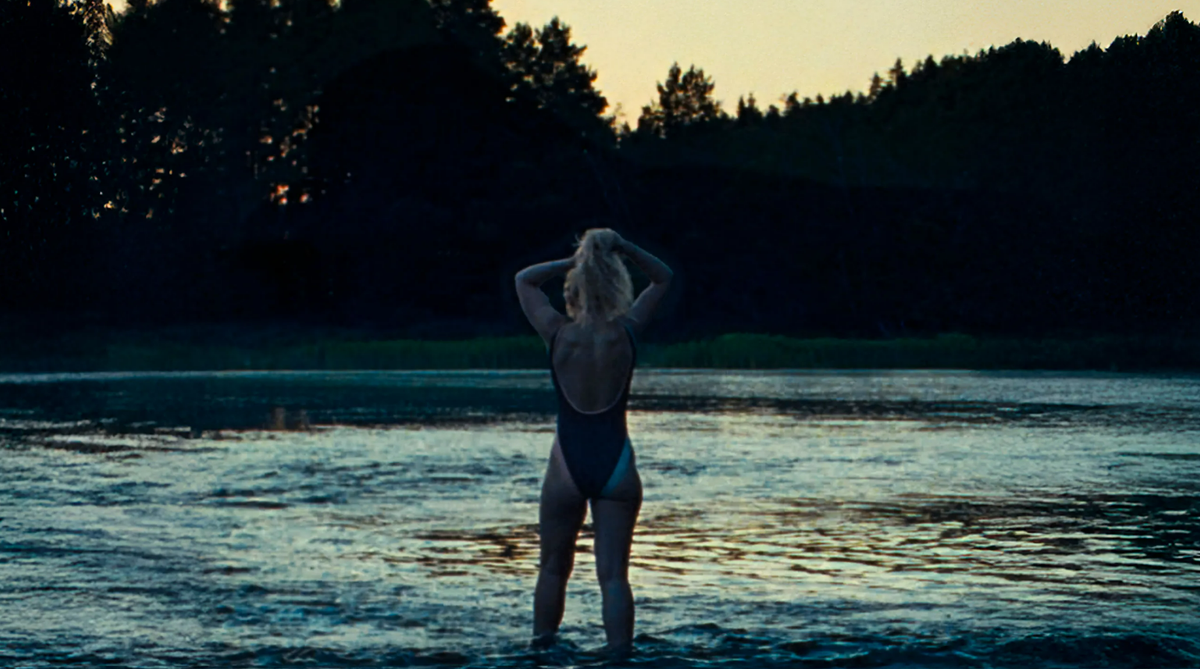
A still from ‘The Chronology of Water’
| Photo Credit:
BFI
A phenomenal Imogen Poots delivers an amphibious performance built from exposure and transformation. She carries Lidia from adolescence through middle age without smoothing the joins. The body does the work. Poots registers want, revulsion, hunger, and exhaustion as physical states, often within the same shot. Her eyes sharpen when desire appears. Her posture collapses when shame takes over. Even joy lands with a tremor, as if it has to pass through prolonged resistance first. Her performance never farms sympathy, simply holding its ground and letting proximity do the rest.
The film’s early passages establish a domestic climate governed by fear and control. Lidia’s father, played by Michael Epp, occupies the frame as a terrorising off-balance force. Stewart frequently keeps him outside the image, letting his voice and gestures encroach without granting him visual dominance. The abuse is staged through implication, sound, and aftermath, and what matters is the imprint it leaves. Lidia’s mother practices absence and silence as a survival tactic, and Thora Birch, as the adult sister, carries endurance in her stillness, her each glance shaped by a sense of complicity.

Swimming offers Lidia an early system of control. In the water, the body obeys rules that feel earned. Stewart films these sequences with restraint, allowing the repetition of flesh and liquid to do the work. When that structure collapses, the film pivots into a period of drift. Sex, drugs, and volatility are now interspersed as attempts at recalibration. Stewart stages sexual encounters through texture and proximity, with skin and breath prioritised over choreography. Pleasure and pain also share the same grammar, avoiding provocation for its own sake and staying focused on cause and consequence.
The act of chronicling her memories and lived experiences comes when Lidia moves to Oregon and enrolls in a creative-writing workshop led by Ken Kesey, played with gravelly generosity by Jim Belushi. As Ken Kesey, Belushi plays the first adult in Lidia’s life who listens without domination, meeting her journals, fragments, and jagged prose with recognition. Their scenes shift the film’s cadence as Kesey pushes her toward precision, toward letting language bear the full weight of experience instead of bleeding it out. Stewart uses voiceover as an extension of that process, letting Yuknavitch’s words exist alongside the images instead of governing them. Writing begins to function as an outlet for Lidia to move forward without erasing what came before.

A still from ‘The Chronology of Water’
| Photo Credit:
BFI
Formally, the commitment to fragmentation can be exhausting, and the renunciation of conventional progression flattens certain transitions. Lidia’s emergence as an established writer appears with an air of inevitability that underplays the labour of the present tense. Scenes sometimes end before behaviour can settle into a recognisable pattern. This constraint affects Poots as well, forcing emotion into emblematic states instead of sustained development. The choice does feel deliberate, aligned with the film’s thesis, but it often narrows the range of modulation. Still, the achievement remains substantial. Stewart demonstrates an instinct for translating interior states into cinematic action without leaning on exposition or sentiment.

The Chronology of Water is a tremendous debutant work shaped by commitment and risk. It continuously resists comfort and trusts sensorial accumulation; Stewart directs with an understanding that fidelity to experience can demand formal experimentation. It holds, even when it strains, because it remains anchored to the body at its centre, attentive to shifts in pressure, buoyancy, and drag, and willing to let those forces determine its course.
The Chronology of Water is currently running in theatres
Published – January 15, 2026 04:26 pm IST


