- January 21, 2026
Adithya Narayanan’s Sahana alapana carried a lot of soul
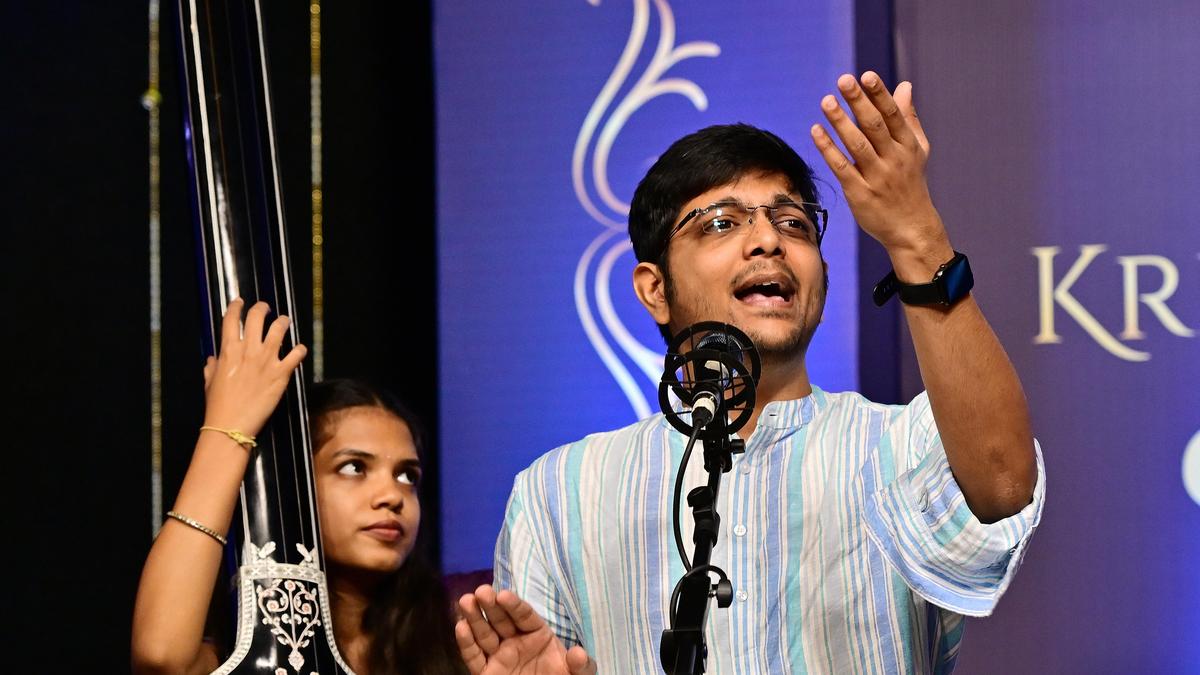
Adithya Narayanan.
| Photo Credit: B. Velankanni Raj
At its core, this was a thoughtful exploration of raga and rasa. S. Adithya Narayanan emphasised rakti and bhava with restraint, avoiding excessive ornamentation. Sruthi Sarathy (violin) complemented his approach with precision, while percussionists Kishore Ramesh (mridangam) and K.R. Sivaramakrishna (kanjira) maintained attentive and balanced support. The quartet demonstrated strong artistic alignment.
The afternoon concert began with the Behag varnam ‘Vanajaksha’, a gentle prelude that created a pleasant atmosphere. Tyagaraja’s Ritigowla kriti ‘Raga ratna malika’ came next. The niraval at ‘Bhagavatho’ was supported by Kishore’s expressive mridangam. The kalpanaswaras carried this synergy forward, Sruthi’s violin aligning well too.

Adithya Narayanan accompanied by Sruthi Sarathy (violin); Kishore Ramesh (mridangam) and K.R. Sivaramakrishna (kanjira).
| Photo Credit:
B. Velankanni Raj
The Sahana alapana delineated the raga’s contour with assurance, through sustained phrases. The deliberately-placed notes drew the audience into a reflective mood. On the violin, Sruthi sustained the effect with clear, understated playing, while preserving her interpretation.
Papanasam Sivan’s ‘Senthil vellaiyya’, a vilamba kala kriti, retained this meditative mode. Its gait was supported by percussion that employed space as strategically as sound.
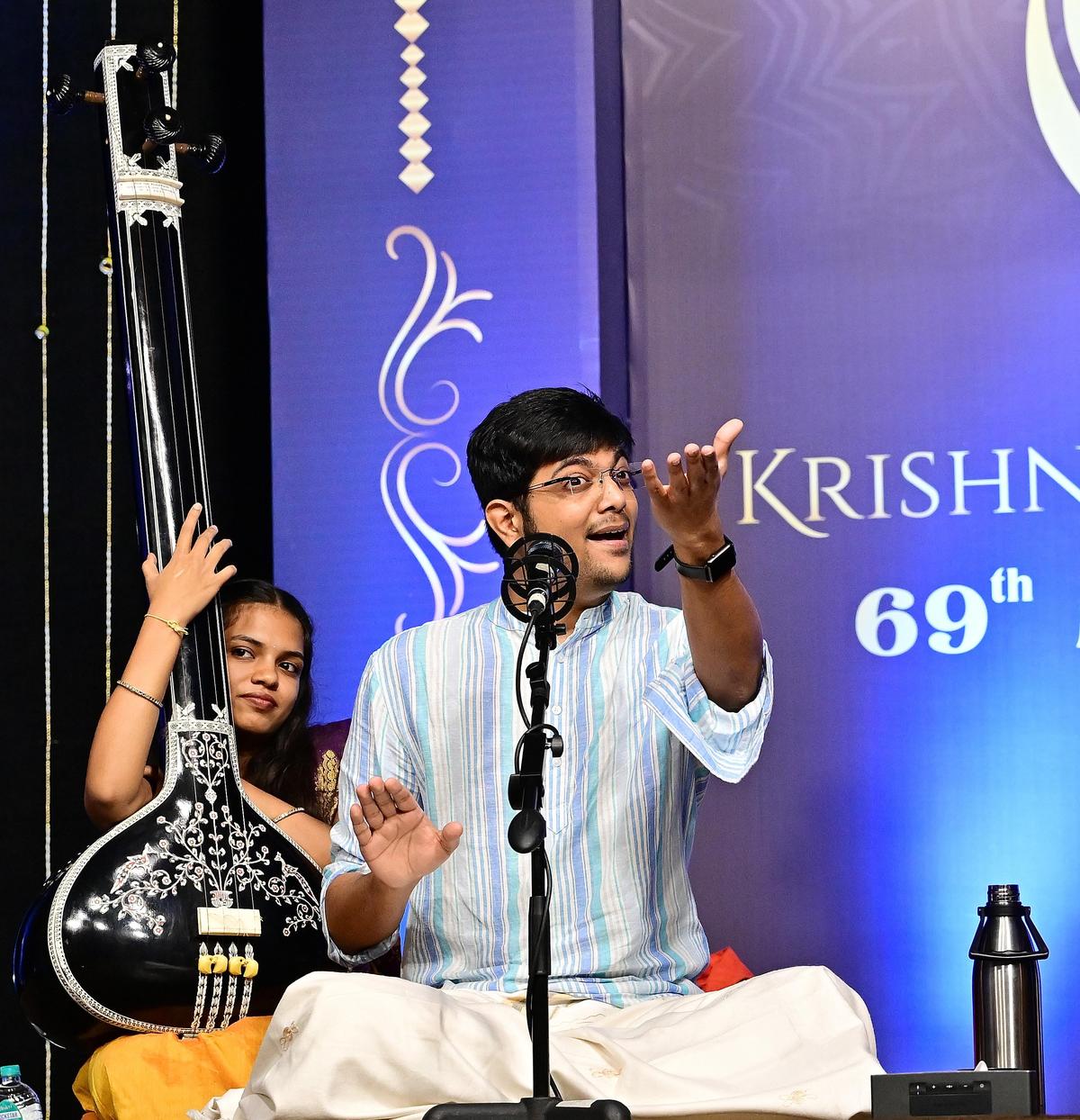
Adithya Narayanan performing at the 69th Margazhi mahotsavam of Krishna Gana Sabha.
| Photo Credit:
VELANKANNI RAJ B
The transition into ’Marubalka’ (Sriranjani) occurred after a brief stage-side conversation. The tanam in Kalyani introduced a noticeable shift, prompting an introspective response that rasikas recognised. The ragaswarupam appeared subtly, with the raga’s emotional core conveyed more through pauses than through the phrases themselves. Tyagaraja’s ‘Etavunara’ followed. At ‘Sri karunaku tyaga’, the niraval acquired briga-brightness without compromising contour.
The tani avartanam was brisk to the point of feeling compressed. Though the korvais were undeniably complex, the segment seemed to sit adjacent to the concert, adding little to the interpretive momentum that existed until then.
The concert closed on a sprightly note with Patnam Subramania Iyer’s Khamas thillana.
Published – January 21, 2026 02:38 pm IST