


- January 24, 2026
Revisiting the musical genius of Harikesanallur Muthiah Bhagavatar
What is the common thread linking ragas such as Mohanakalyani, Hamsanandi, Valaji, Karnaranjani, Pasupathipriya, Gaudamalhar, Sarangamalhar, Vijayanagari, Vijayasaraswathi, Budhamanohari, Sumanapriya and Niroshta? The answer lies in one of the most significant contributions of Harikesanallur Muthiah Bhagavatar (1877–1945) to Carnatic music: he was the composer who first gave form and life to these ragas through his kritis.
Erudition, an affluent background and a commanding presence placed Muthiah Bhagavatar among the elite in the musical world. He was the first musician in India to be awarded a doctorate (in 1943), and is credited with nearly 500 kritis composed across Sanskrit, Telugu, Tamil and Kannada.
To mark Muthiah Bhagavatar’s 148th Jayanthi, the Gurukrupa Trust — under the mentorship of maestro T.N. Seshagopalan — recently organised an award ceremony and a lecture-demonstration on the musician-composer, Sanskrit scholar, vaggeyakara, musicologist and Harikatha exponent at Ragasudha Hall.
While violin virtuoso M. Chandrasekaran was honoured with the ‘Gayaka Shikamani Dr. Harikesanallur Muthiah Bhagavathar Award’, there could not have been a fitter presenter for the lec-dem than Seshagopalan himself — a direct musical descendant, being a disciple of Ramanathapuram C.S. Sankarasivam, whose guru was Muthiah Bhagavatar.
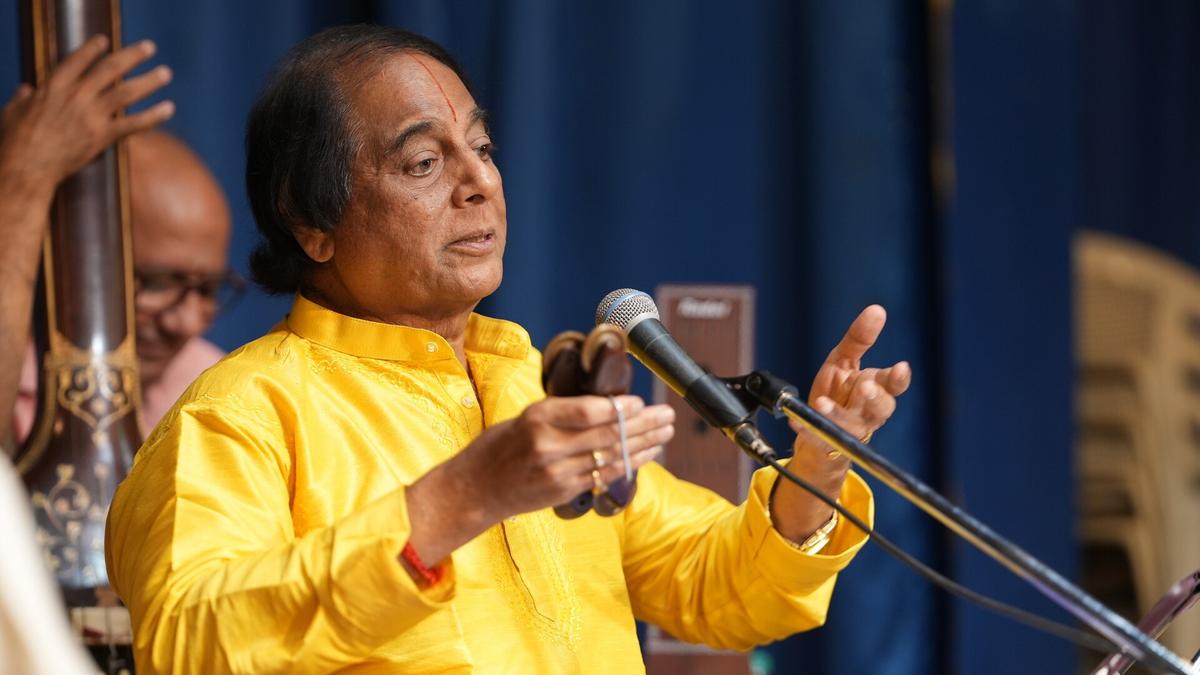
T.N. Seshagopalan accompanied by T.N.S. Krishna (vocal support), R.K. Shriramkumar (violin), and Trichur C. Narendran (mridangam).
| Photo Credit:
Nick Haynes
A multi-faceted musician himself, T.N. Seshagopalan has popularised scores of Bhagavatar’s compositions and has even set chittaswaras for about 15 of them. He began with Bhagavatar’s Sriranjani kriti ‘Sakthi vinayaka’ followed by his own shloka ‘Manda smitha mukhamboruham’ extolling his paramaguru’s personality. He regaled the audience with interesting anecdotes and insightful snippets from Bhagavatar’s life, weaving them together with his tongue-in-cheek humour. T.N.S. Krishna lent vocal support and seasoned accompanists R.K. Shriramkumar (violin) and Trichur C. Narendran (mridangam) provided admirable instrumental backing.
Orphaned before age nine, Muthiah Bhagavatar was raised by his maternal uncle Lakshmana Suri, father of musicologist T.L. Venkatarama Iyer. Grounded initially in the Vedas, he then underwent rigorous musical training in Thiruvaiyaru. He returned to Harikesanallur at 16, hailed as a ‘Maha Gayaka’ and earned the patronage of Moolam Tirunal of Travancore when he was barely 20.
Seshagopalan dismissed the notion that Bhagavatar turned to Harikatha at 27 due to a fading voice, explaining that he sought a wider audience amid its growing public craze. In doing so, he innovatively enriched its repertoire by incorporating forms such as kavadi chindhu, Nondi chindhu, kili kanni, themmangu, virutham and shloka. He noted, with a touch of humour, that vocalists of that era possessed ‘mayakku (mesmerising) voice’ unlike today’s reliance on amplified ‘mic voice’.
Bhagavatar’s discourses, particularly on ‘Valli Parinayam’, ‘Tyagaraja Divya Charitram’ and ‘Tyagaraja Ramayanam’, gained immense popularity; and he even delivered one praising the British rule, reflecting the era’s complexities of patronage. He also introduced new ideas and songs for specific situations in his performances. The ‘English Note’, later made famous by Madurai Mani Iyer, was one such improvisation as he sang it in ‘Rukmini Kalyanam’ and ‘Subhadra Kalyanam’, using its rhythmic drive to musically mimic a speeding chariot in abduction scenes. He also adopted it for the Durvasa Bhiksha episode, varying the tempo to suit the situation.
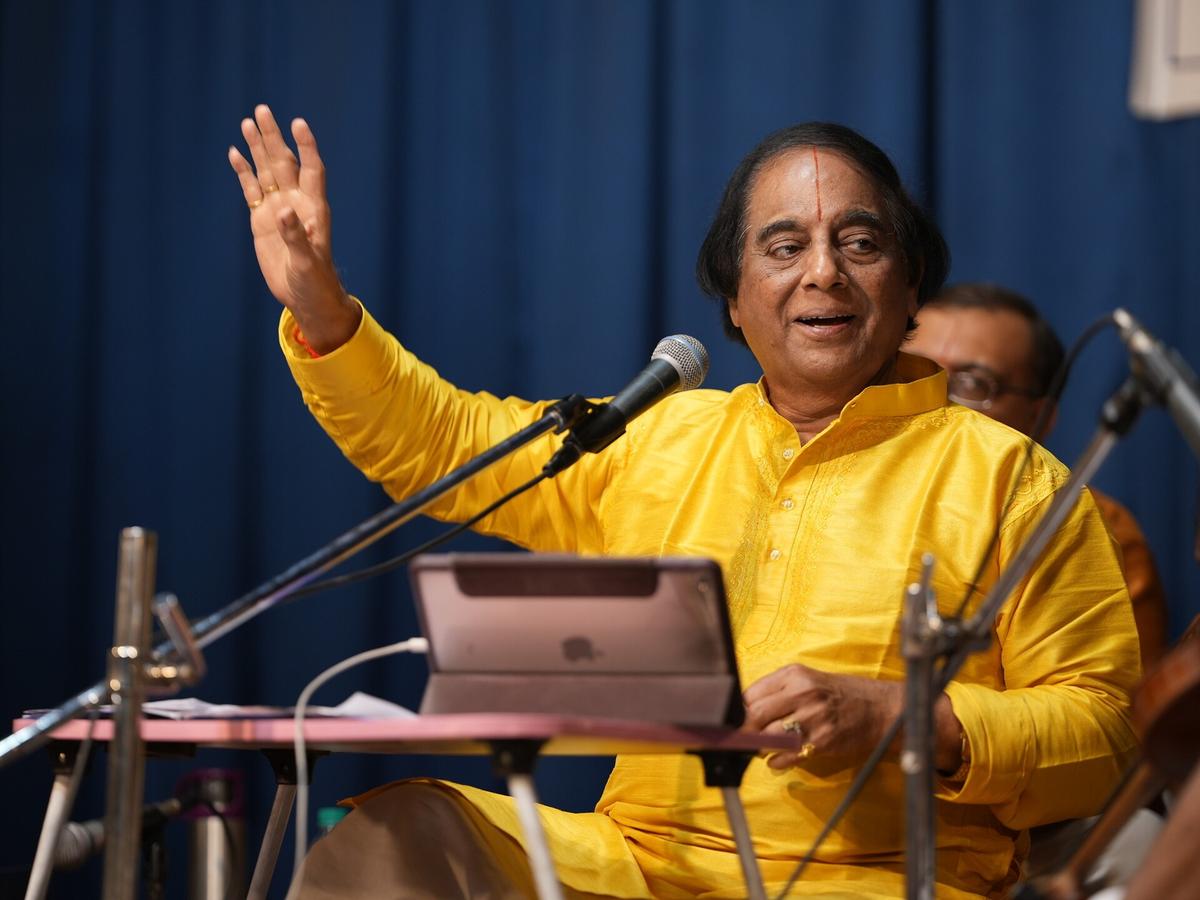
T.N. Seshagopalan demonstrated how the third muktayi swara in the Mohanam kriti ‘Manamohan’ can be interpreted as sahityam also.
| Photo Credit:
Nick Haynes
Seshagopalan said that the tana varnam ‘Manamohana’ in Mohanam was created by Bhagavatar for the Arangetram of his disciple Sankarasivam. He demonstrated how the third muktayi swara therein can be interpreted as sahityam also. Similarly, he highlighted the daru varnam ‘Mathe’ in Khamas where the entire final charanam is an example of masterful swarakshara sahityam.
Bhagavatar’s stay in Varanasi and his exposure to Hindustani music, particularly raga Sohini, resulted in his Hamsanandi kritis, and Pasupathipriya was an inspiration from raga Durga. His creative acumen was recognised nationally when he composed the Vijayanagari-based signature tune for All India Radio. He also composed about 10 thillanas.
According to Seshagopalan, crediting someone with ‘inventing’ or ‘creating’ a raga (barring the vakra variety) is a misnomer. He asserted that a raga can only be discovered, and never created, because its constituent notes have always existed.
No narrative on Bhagavatar’s music could be complete without reference to his ingenious kriti ‘Rajaraja radhithe’ in Niroshta. The raga is formed by the five notes that do not involve lip movement (excluding ma and pa). The prefix ‘Nir’ means ‘devoid of’ and the noun ‘Oshta’ refers to lips. In a stunning parallel, the entire lyrics — not just the swara structure of the raga — shun labial consonants, not requiring the lips to press together. Seshagopalan said he composed a thillana in the raga, inspired by his paramaguru.
The engaging presentation concluded with Bhagavatar’s ‘Mangalam bhavatu’ in Pantuvarali.
Published – January 24, 2026 04:50 pm IST


