- April 17, 2026
Shredded to cosmic dust: Stunning footage captures comet’s death plunge into the Sun — watch – The Times of India
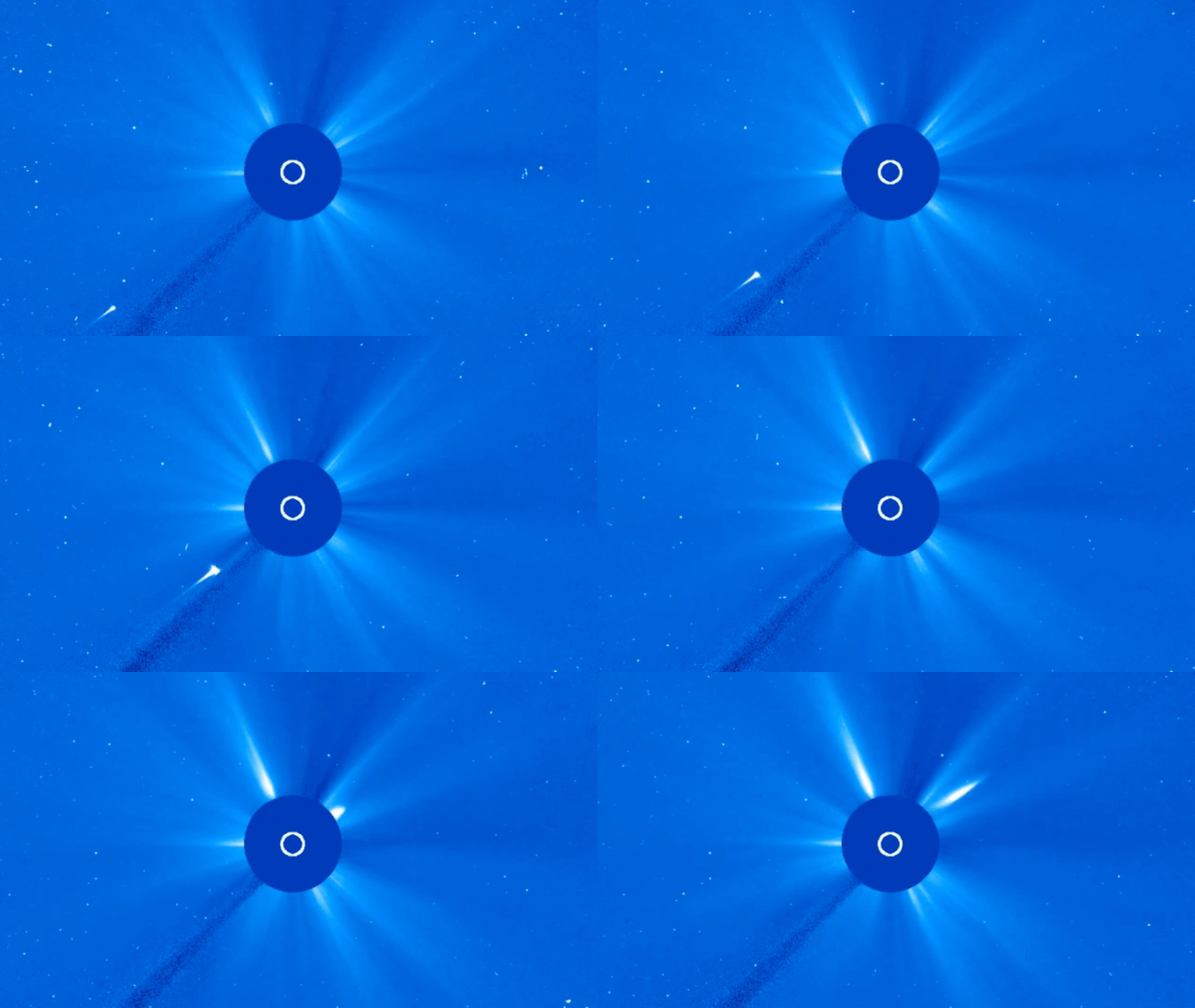
Nasa heliophysics spacecraft observed the destruction of comet C/2026 A1 (MAPS) during its close approach to the Sun on April 4, according to data from SOHO (Solar and Heliospheric Observatory), a joint Nasa–ESA mission, along with Nasa’s STEREO and PUNCH spacecraft. The comet passed at a distance roughly twice that between the Earth and the Moon and disintegrated as it neared the Sun, after initial observations suggested it might survive its perihelion passage.Observations from SOHO showed the comet entering the field of view of its coronagraph instrument, which blocks the Sun’s bright disc to reveal faint nearby objects. The comet appeared intact before passing behind the instrument’s occulting disk, but later frames revealed only a diffuse cloud of dust emerging, indicating it had broken apart during its solar approach.Nasa also shared a striking image capturing the final moments of comet C/2026 A1 (MAPS) as it disintegrated during a close approach to the Sun.The processed image, released from Nasa’s PUNCH mission was shared by the space agency in a post on X, and showed the comet on its first — and fateful last — observed flyby of the Sun, appearing as a diffuse cloud of dust after breaking apart. From a different vantage point, Nasa’s STEREO (Solar Terrestrial Relations Observatory), positioned about 54.5 degrees from the Sun–Earth line, captured the comet arcing around the Sun before it disintegrated into a dust cloud. “The comet was clearly destroyed — likely several hours before its closest approach to the Sun,” said Karl Battams of the U.S. Naval Research Laboratory, principal investigator for SOHO’s coronagraph, known as LASCO.Nasa’s PUNCH (Polarimeter to Unify the Corona and Heliosphere) mission also tracked the comet prior to its disintegration, while the broader heliophysics fleet provided complementary multi-angle observations of the event. Scientists say such coordinated observations help improve understanding of cometary structure and conditions in the early solar system.The comet, discovered on January 13 by a Chile-based telescope operated by the MAPS programme, belongs to the Kreutz sungrazing family of comets, which pass extremely close to the Sun and are believed to be fragments of a larger comet that broke apart centuries ago.