- May 3, 2026
Assam Election Results: Will Himanta Biswa Sarma Get A Second Term As CM?
Last Updated:
Assam election results: While BJP-led alliance appears to have an edge, the presence of a stronger opposition means the final outcome could hinge on narrow margins in key seats




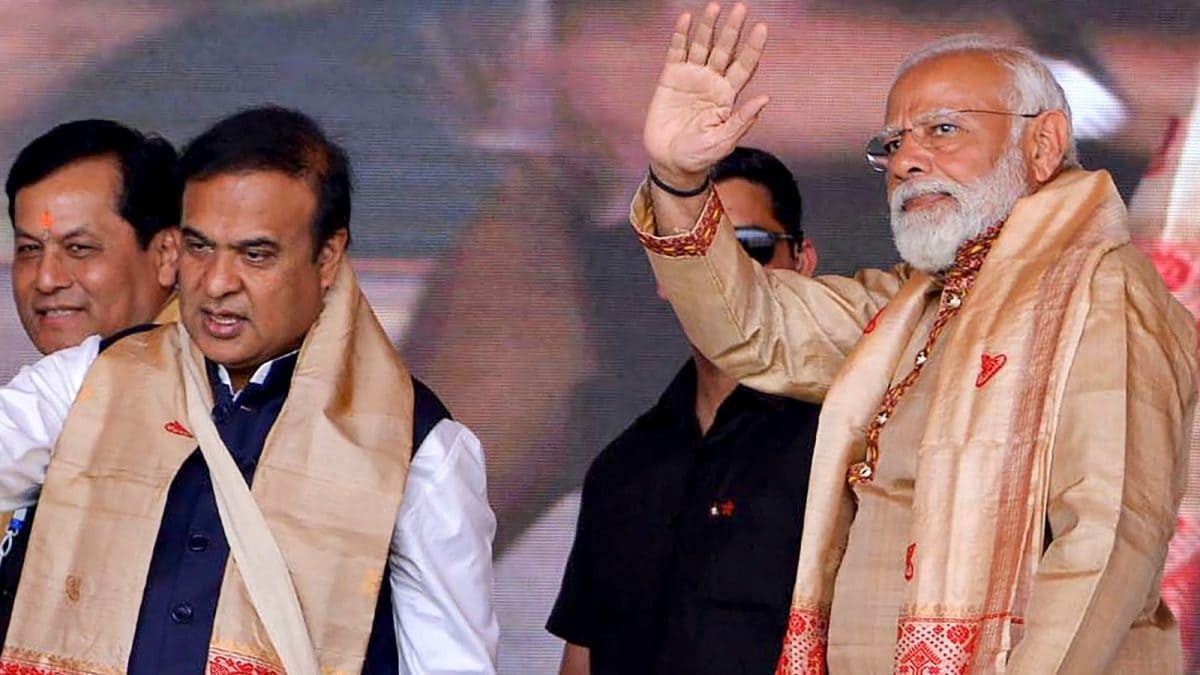
Himanta Biswa Sarma and PM Narendra Modi at a rally. (PTI File)
Assam heads into the counting day (May 4) with high turnout, a competitive contest, and exit polls favouring continuity but not dominance.
While the Bharatiya Janata Party-led alliance appears to have an edge, the presence of a stronger opposition means the final outcome could hinge on narrow margins in key seats, making the result keenly watched across the country.
WHAT WAS THE TURNOUT?
The state has a total of 126 Assembly seats, which means the majority mark stands at 64 seats.
The Assembly election in Assam saw a high voter turnout of around 85-86%, reflecting strong public participation across both urban and rural regions.
This high turnout is significant because it indicates a highly engaged electorate and often points to a competitive contest, where both incumbency support and anti-incumbency sentiment may be at play. Historically, such strong participation levels in Assam have made outcomes less predictable, especially in closely fought constituencies, say experts.
THE CONTEST
The election in Assam is primarily a contest between the ruling Bharatiya Janata Party-led alliance and a consolidated opposition front led by the Indian National Congress along with regional partners. The BJP, which has been in power since 2016, is seeking to retain control by highlighting governance, infrastructure development, and welfare delivery. It is also a key battle for CM Himanta Biswa Sarma, who is eyeing a second term.
On the other side, the opposition is attempting to capitalise on local issues, anti-incumbency sentiment, and alliance arithmetic to challenge the ruling coalition. While the BJP remains the dominant force, the contest is not one-sided, as opposition unity has made several seats tightly contested battlegrounds.
WHAT IS AT STAKE?
For the Bharatiya Janata Party and its allies, the stakes are about retaining political dominance in the Northeast and reinforcing their governance record in Assam. A win would consolidate their position as the primary political force in the region and strengthen their narrative of stability and development.
For the Indian National Congress-led opposition, this election represents a crucial opportunity to stage a comeback in a key northeastern state and reassert its relevance through coalition politics. The outcome will also influence the broader political balance in the Northeast, making Assam a strategically important state beyond its numbers.
WHICH ARE THE KEY CONSTITUENCIES?
Several constituencies are being closely watched due to their political significance and potential to influence the overall result.
Upper Assam (politically influential belt)
- Dibrugarh: A major political and economic hub; trends here often reflect broader Upper Assam sentiment.
- Jorhat: High-profile seat with strong political visibility and urban-rural mix.
- Sivasagar: Historically significant and politically active constituency.
These seats indicate core support zones and swing patterns.
Central Assam (mixed demographics, swing region)
- Nagaon: One of the most crucial seats due to demographic diversity.
- Morigaon: Often closely contested; reflects shifting alliances.
Important for vote consolidation and coalition impact.
Lower Assam (high electoral volatility)
- Barpeta: Politically sensitive with tight contests historically.
- Dhubri: Key seat with strong influence on regional outcome.
These can swing results in a close election.
Barak Valley (distinct political dynamics)
- Silchar: Urban stronghold and politically symbolic seat.
- Karimganj: Important for regional balance and identity politics.
Often behaves differently from the rest of Assam.
WHAT EXIT POLLS SAY
Exit polls for Assam suggest a continuing advantage for the BJP-led alliance, with many projections indicating that it could cross the majority mark, though often with reduced margins compared to previous elections.
Some polls hint at gains for the opposition, reflecting a closer contest in several constituencies, but not necessarily enough to unseat the ruling alliance.
Overall, the exit poll consensus leans towards BJP retention, but with tighter margins, which means that actual results could still throw up surprises if local swings go against predictions.
Read More