- June 6, 2026
From Grain Aid Under Nehru To Free Ration For 80 Crore Under Modi: India’s Food Security Shift
Last Updated:
India once depended on foreign grain shipments to manage shortages. Decades later, under PM Modi, it runs one of the world’s largest food security programmes.




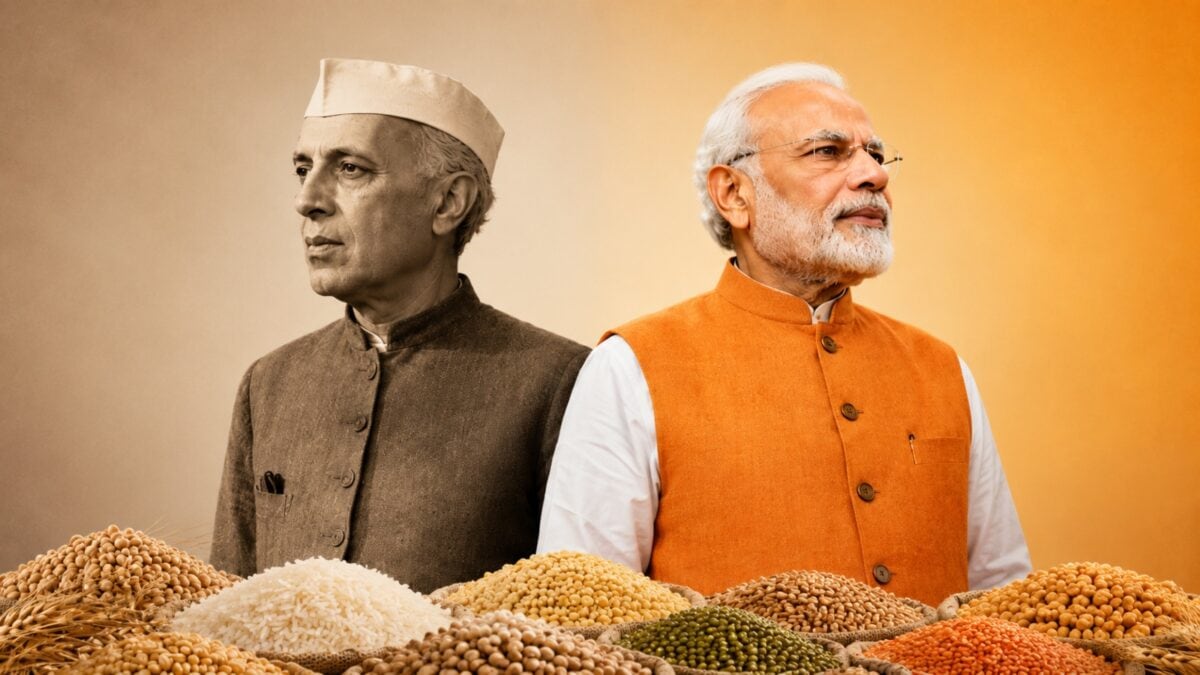
India’s food security story has moved from foreign grain dependence in its early decades to large-scale welfare delivery under PM Modi. (AI-generated image)
India once depended on foreign grain shipments to feed its people. More than seven decades later, it is running one of the world’s largest food security programmes, supplying free foodgrains to over 80 crore people.
That shift — from foreign aid-backed food security in the Nehru era to large-scale welfare delivery under PM Modi — captures one of India’s most dramatic post-Independence transformations.
As PM Modi nears the milestone of surpassing Jawaharlal Nehru as India’s longest democratically elected, continuously serving Prime Minister on June 10, 2026, India’s food security journey offers a sharp contrast between two very different eras.
Why Was India Dependent On Foreign Grain In The Nehru Era?
During Jawaharlal Nehru’s tenure, India was still struggling with low agricultural productivity, limited irrigation, dependence on the monsoon and recurring food shortages. The country had recently emerged from colonial rule and Partition, and feeding a large, poor and growing population was one of the biggest challenges before the new republic.
India’s foodgrain production in 1950-51 stood at 50.82 million tonnes, according to the Ministry of Agriculture and Farmers Welfare. Shortages forced the country to depend on foreign grain assistance, especially from the United States under Public Law 480, or PL-480. The arrangement helped India manage immediate food gaps, but it also reflected the vulnerability of a young nation whose food security depended partly on shipments from abroad.
That phase gave rise to the phrase “ship-to-mouth”, used to describe a situation where food availability depended heavily on incoming grain supplies. While the worst of this dependence stretched into the 1960s, the roots of India’s food insecurity lay in the early decades after Independence.
From Scarcity To Self-Sufficiency
India’s transformation did not happen overnight. After the Nehru years, the Green Revolution became the turning point in the country’s food journey, with agricultural scientist M.S. Swaminathan playing a central role in helping India move towards food self-sufficiency.
Often called the father of India’s Green Revolution, Swaminathan helped drive the use of high-yielding crop varieties, scientific farming practices and agricultural research systems that transformed India’s wheat and rice production. His contribution laid a firm foundation for India’s food security.
The Green Revolution was backed by expanded irrigation, fertiliser use, procurement systems and public distribution. The Food Corporation of India was set up in 1965, when the country was facing major foodgrain shortages, especially wheat, according to the Department of Food and Public Distribution.
Over time, this helped India move from shortage and dependence to procurement, buffer stocks and large-scale distribution.
From Grain Dependence To Welfare At Scale
Under PM Modi, the food security story moved from scarcity management to welfare delivery at scale during the Covid-19 pandemic. The Pradhan Mantri Garib Kalyan Anna Yojana was officially launched on March 26, 2020, at the onset of the pandemic to provide relief to underprivileged citizens, including Antyodaya Anna Yojana and Priority Household beneficiaries.
In March 2020, the government announced additional free rice and wheat for about 80 crore beneficiaries under the National Food Security Act, at 5 kg per person per month over and above their regular monthly ration entitlement. In effect, this doubled the monthly foodgrain support normally delivered to these households during the economic crisis.
The scheme later evolved into a wider food security framework. From January 1, 2023, the government rolled out a revamped integrated food security scheme under the same name, making foodgrains entirely free for all National Food Security Act beneficiaries.
The Union Cabinet, in November 2023, approved the continuation of PMGKAY for five years from January 1, 2024, covering 81.35 crore beneficiaries. The scheme will remain in force till December 2028 and is being implemented through a network of over five lakh fair price shops across the country.
The larger shift is that India is no longer dependent on external food assistance. It is among the world’s largest food producers, has built record procurement and digital distribution systems, and continues to run one of the world’s largest food security programmes. Through POSHAN Abhiyaan, nutrition support is also reaching crores of children, pregnant women and mothers.
India has gone from dependence on imported grain to becoming a major food producer with export capacity, even while running a massive domestic food security programme.
The Modi-Era Delivery Shift
The Modi government’s food security approach has also focused on delivery reforms. The One Nation One Ration Card system has sought to make ration access portable, especially for migrant workers who move across districts and states for employment.
According to PIB, One Nation One Ration Card covers nearly 81 crore NFSA beneficiaries across states and Union Territories, allowing eligible households to access their foodgrain entitlement outside their home state or district.
This matters because food security is not only about producing enough grain. It is also about ensuring that the grain reaches the beneficiary. Portability, digitised ration cards and better tracking have become part of the government’s attempt to reduce barriers in the public distribution system.
India’s foodgrain production has also reached record levels. According to the Ministry of Agriculture and Farmers Welfare’s latest estimates, total foodgrain production for 2025-26 is estimated at 376.563 million tonnes, nearly 18.8 million tonnes higher than the previous year’s production of 357.732 million tonnes.
From Dependence To Delivery
The contrast across eras is clear. In the Nehru years, India was still trying to overcome shortages, raise production and reduce dependence on foreign grain. The Green Revolution later gave the country the production base needed for self-sufficiency. Under PM Modi, that base has been used to build a welfare system that can supply free foodgrains to over 80 crore people.
The shift is not only from scarcity to availability, but from availability to assured access.
About the Author

The News Desk is a team of passionate editors and writers who break and analyse the most important events unfolding in India and abroad. From live updates to exclusive reports to in-depth explainers, …Read More
Read More