- October 7, 2026
3 years after October 7 Hamas attack: A scarred Israel, a devastated Gaza and a Middle East no longer the same
Three years after Hamas’s October 7, 2023 attack on Israel, the shockwaves of that day continue to shape lives, politics and security across the Middle East. What began as a devastating assault on southern Israel grew into a prolonged war in Gaza and then widened into a regional confrontation involving Hezbollah, the Houthis, Iran and Iran-backed groups.The conflict has left behind two deeply traumatic realities – the Israeli experience of the attack, hostage-taking and continuing security fears, and the Palestinian devastation caused by the war in Gaza. Beyond the immediate human cost, the conflict has also altered alliances, weakened Iran’s regional network, changed Israel’s military calculations and disrupted diplomatic efforts across the region.For those who lived through October 7, however, the consequences are not measured only in geopolitical shifts. They remain embedded in ordinary moments, places and memories, reminders of a day that transformed the meaning of safety, freedom and home.“The smell of hell.”That is how one Israeli resident describes what a barbecue now smells like.Living close to Gaza, Deganit Bar Hay told AP the smell of burnt flesh has become a trigger, making it difficult for her to barbecue.
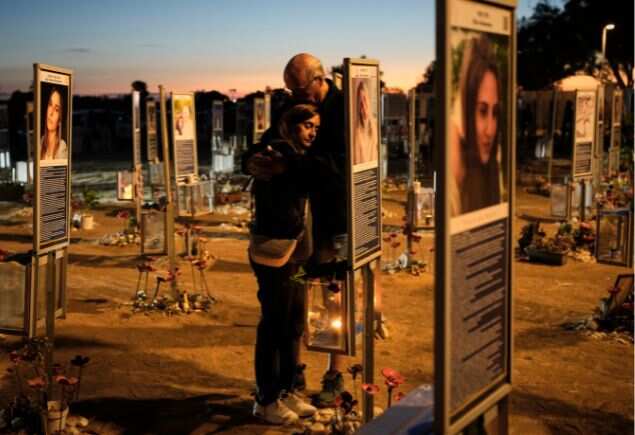
Benny and Maggy Solomon, parents of Oct 7 victim Hila Solomon, attend a memorial at the Nova festival site in southern Israel (Credit: AP)
Along the highway running parallel to the Gaza Strip, where people were gunned down while trying to flee on October 7, memorials now stand beside the road.Cars smashed and riddled with bullets have been preserved elsewhere, stacked in rusting heaps. Portraits of young female military spotters, whose warnings about a possible attack were disregarded, mark another set of lives lost that day.For those who survived the attack and those who were taken hostage, the meaning of ordinary life changed too.“Freedom has completely changed the way I see life,” Emily Damari, who was abducted wounded from her home in Kibbutz Kfar Aza and released in January 2025, told Reuters.After captivity, she said, even opening a refrigerator or drinking cold water felt like something to be grateful for. “Being free, at home, surrounded by my family and my people is something I will never take for granted again.”Eli Sharabi, taken hostage from nearby Kibbutz Be’eri, spent 491 days in captivity. His wife Lianne and daughters Noiya and Yahel were killed in the October 7 attack, while his brother Yossi was taken hostage and died in Gaza. Released in February 2025 emaciated after what he said was prolonged hunger, shackling and beatings, Sharabi told Reuters: “I choose life. I choose to keep living fully, while carrying Lianne, Noiya, Yahel and Yossi with me in everything I do.”Three years later, those memories remain raw in Israel. But there is another landscape of memory just across the border.In Gaza, children are growing up with different reminders of the same war – lost parents, amputations, displacement, damaged homes and years without anything resembling a normal childhood. DW reported the stories of 15-year-old Mahmoud Abu Shadaq, recovering from injuries caused by an airstrike, and eight-year-old Layan Abed, who lost her father during the conflict.Aid groups are providing rehabilitation and mental-health support, but the scars are likely to outlast the fighting.That is the paradox at the heart of the three years since October 7.One attack produced two vastly different but deeply traumatic legacies – the Israeli trauma of the assault and hostage-taking, and the Palestinian devastation that followed Israel’s military campaign in Gaza.And the consequences did not stop at Gaza’s borders.What began with Hamas’s assault on southern Israel became a war in Gaza, then a wider confrontation involving Hezbollah, the Houthis, Iran and Iran-backed groups across the region. It has altered Israel’s security doctrine, weakened Iran’s regional network, unsettled Arab states, disrupted diplomacy and pushed the Middle East into a new and still uncertain balance of power.Three years on, the question is no longer simply what happened on October 7. It is what October 7 set in motion.
October 7, 2023: Day the ‘iron’ wall broke
Just before 6.30am on October 7, 2023, Israel’s much-vaunted “iron wall” along Gaza began to fail. Explosives dropped by drones knocked out communication towers and remote-controlled guns, while snipers targeted sensors and cameras. Israeli defenders were left staring at blank screens as roughly 2,200 rockets rained towards southern and central Israel.
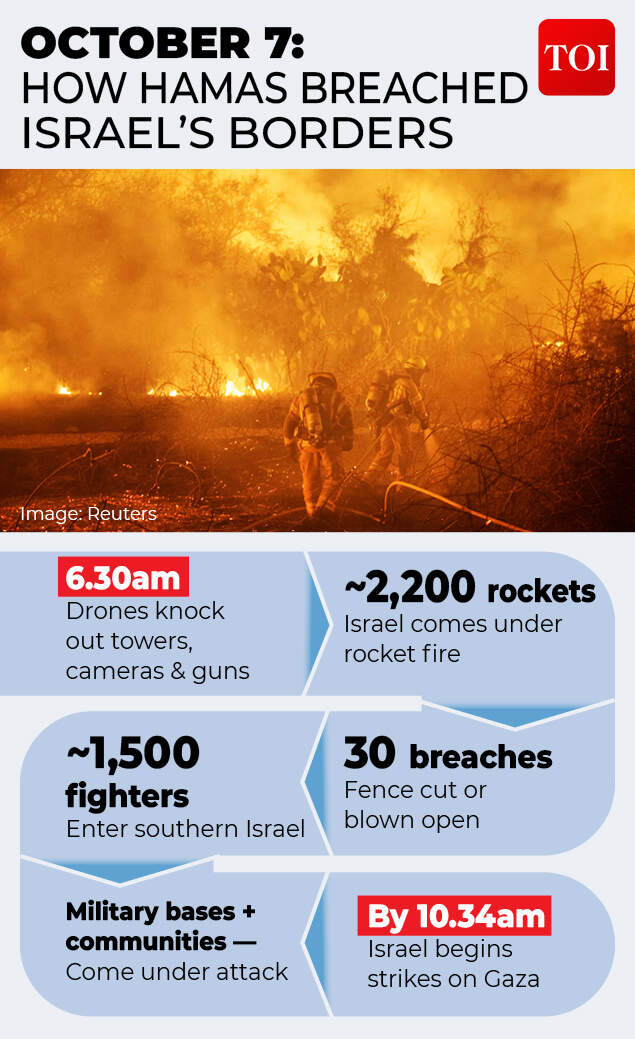
A minute-by-minute look at how the October 7 assault broke through Israel’s border defences.
Then came the breach. Hamas fighters cut through the 20-foot-high fence or blew openings into it. Motorbikes, pickup trucks and bulldozers poured through, followed by hundreds of armed men. Others arrived on motorised paragliders. About 30 breaches were eventually made, allowing an estimated 1,500 fighters into Israel, The Guardian reported.It was more than a fence being breached. It was the collapse of an assumption — that Israel’s technology, intelligence and military superiority had made a large-scale assault from Gaza almost impossible.“We have decided to put an end to all of the occupation’s crimes,” Hamas commander Mohammed Deif announced as the attack began, declaring the “al-Aqsa deluge”.Within hours, the assault had turned deadly. Fighters stormed military positions and nearby communities, reaching the Supernova music festival, where at least 260 people were killed and others taken hostage. In kibbutzim such as Be’eri, residents barricaded themselves inside reinforced rooms as gunmen moved through the communities. At Zikim, soldiers at a military base were overwhelmed before reinforcements arrived.Files, images, and data analysis are unavailable until usage resets tomorrow at 2:01 AM. Continue chatting with text only, or upgrade for more access.The scale of the failure soon became clear.Israeli intelligence had detected increased communications activity among militants in Gaza before the attack. Egyptian security services had also warned of an impending event. But Israeli officials assessed the activity as connected to a military exercise and decided that the alert level did not need to be raised, The Guardian reported. Three surveillance balloons used to monitor the border had also broken down and had not been replaced.The result was a catastrophic intelligence and preparedness failure: a border designed to keep Gaza’s militants out became a route into Israel, while the forces meant to respond were caught unprepared.For people inside the communities along the border, the technological failure quickly became intensely personal.In Nirim, resident Eldad Hess and his family hid inside a reinforced shelter as gunfire erupted outside. “Ten minutes later we heard automatic rifle shots outside the house,” Hess told The Guardian. “I understood what was happening but in my heart I couldn’t believe what was happening.”His family survived. Others did not.By late morning, Israel had declared war. At 10.34am, Israeli strikes began hitting Gaza. At 11.35am, Prime Minister Benjamin Netanyahu told Israelis: “Citizens of Israel, we are at war. Not an operation, not a round – at war.”The language of the conflict changed almost as quickly as its geography.The attack had begun as a meticulously planned assault on southern Israel. Within hours, it had become the opening act of a war that would transform Gaza, redraw Israel’s security calculations and eventually pull much of the Middle East into its orbit.
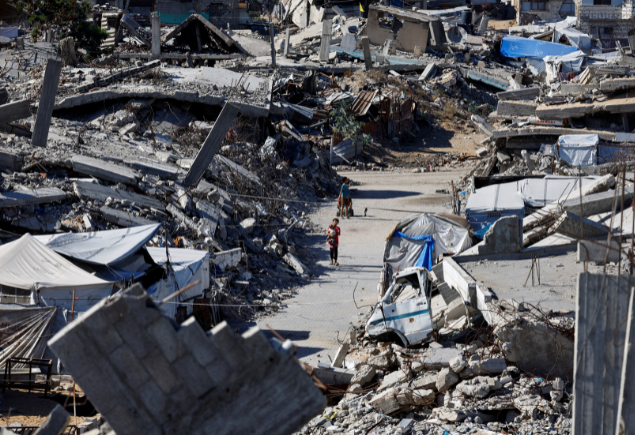
Palestinian children walk amid the rubble of buildings destroyed during Gaza war (Credit: Reuters)
Gaza became war’s price, and its unfinished question
The military campaign that followed October 7 devastated Gaza.Entire neighbourhoods were destroyed, millions were displaced and a generation of children has grown up amid death, injury and uncertainty. The humanitarian crisis became one of the defining consequences of the war.Even after a ceasefire agreement in October 2025 secured the release of the remaining hostages and hundreds of Palestinian prisoners and detainees, the larger Gaza question remained unresolved.According to Reuters, Israeli strikes have continued despite the ceasefire. Gaza’s health ministry says at least 1,400 Palestinians have been killed since the truce, while Israel says its strikes target Hamas and accuses the group of trying to rearm and carry out attacks. Hamas denies the accusation.Meanwhile, Israel’s effective control over Gaza has expanded to around two-thirds of the enclave, Reuters reported. The advance of the Israeli-controlled “yellow line” has squeezed Gaza’s roughly 2 million residents into a shrinking coastal area where many live in tents or damaged buildings.The numbers tell one part of the story. The more difficult question is what happens next.Trump’s plan envisaged Hamas disarming, Israeli forces gradually withdrawing, an International Stabilization Force taking over security and a new Palestinian technocratic administration governing Gaza.None of those pieces has fully fallen into place.The proposed force has a commander and commitments from several countries but has yet to be assembled. A Palestinian technocratic governing body appointed in January has yet to enter Gaza. Hamas has indicated a willingness to hand its weapons over for storage under a US-backed Palestinian administration, but Israel has rejected any withdrawal before complete disarmament.And reconstruction is barely beginning.A $2.45 billion plan announced by the Board of Peace in September is dwarfed by an EU-UN estimate of $71.4 billion needed for recovery and reconstruction over the next decade, Reuters reported.The war may have ended in parts of Gaza. The question of what Gaza becomes has not.
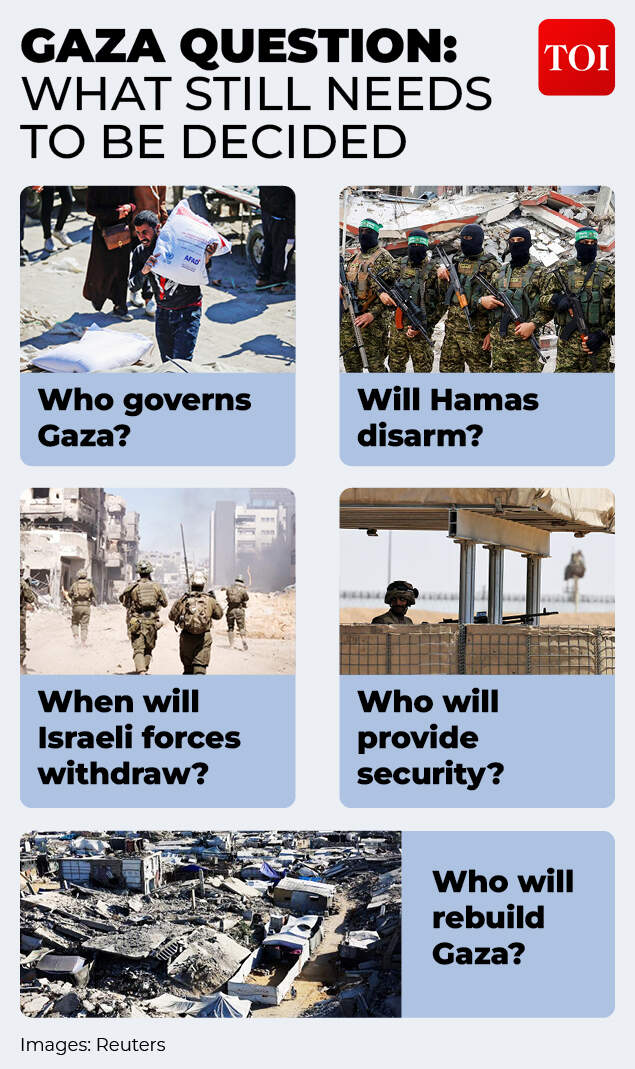
Even after years of war, the biggest questions over Gaza’s governance, security, disarmament and rebuilding remain open
The war crossed the fence, then crossed borders
The first major regional spillover came from Lebanon.Hezbollah, Iran’s most powerful regional ally, entered the conflict, opening another front along Israel’s northern border. What had been a long-running Israel-Hezbollah confrontation now became part of the October 7 war.Then came Yemen.The Houthis attacked Israel and targeted shipping in the Red Sea, turning a conflict thousands of kilometres away into a threat to one of the world’s busiest maritime corridors. US and British military action followed.Iran-backed groups in Iraq and Syria also became part of the wider confrontation.The significance was larger than the individual attacks. October 7 demonstrated that a war involving Israel and Hamas could activate an entire network of armed groups built over decades.And then the network itself began to fracture.
Iran’s ‘axis of resistance’ stopped looking invincible
Before October 7, Iran’s regional influence appeared formidable.Hamas governed Gaza. Hezbollah possessed a vast arsenal in Lebanon. Bashar al-Assad remained in power in Syria. The Houthis controlled large parts of Yemen and threatened shipping lanes. Behind them stood Iran, whose missiles and nuclear programme had long been central to Israeli and Western security calculations.Three years later, that picture has been transformed.Hamas lost its top leadership, including Yahya Sinwar, who was killed by Israel in October 2024. Hezbollah suffered major losses. Assad is no longer in power in Syria. Iran’s own territory has come under direct Israeli and US military attack.“The old order — Iran as the region’s disruptive spine, its proxies as the tools of pressure and deterrence — is gone,” Bilal Saab, a Chatham House fellow and former Pentagon official, told The Washington Post.Ali Vaez, director of the Iran Project at the International Crisis Group, put the change more starkly: “This has changed the region forever.”But a weakened Iran does not automatically mean a more stable Middle East.
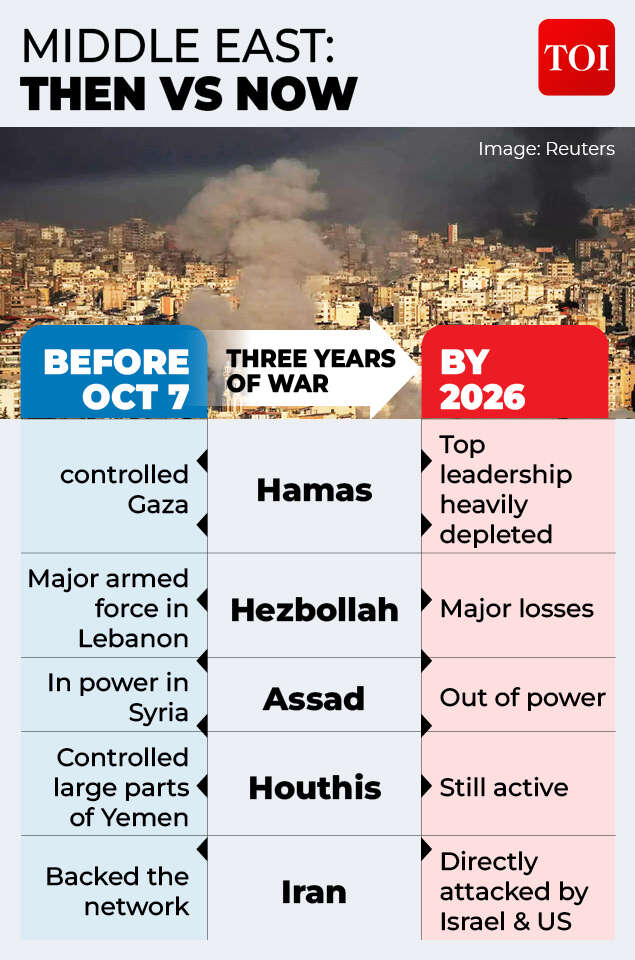
The conflict widened from Gaza to Lebanon, the Red Sea, Iraq, Syria and eventually direct Israel-Iran confrontation
Shadow war finally came into open
For decades, Israel and Iran largely fought without declaring a conventional war against each other — through proxies, covert operations, assassinations, cyberattacks and strikes on Iranian-linked targets.October 7 accelerated the collapse of that distance.The confrontation increasingly moved from the shadows into direct exchanges of missiles and drones, exposing the limits of the old system of indirect deterrence.For Israel, the result has been a dramatic increase in military dominance.A former senior Israeli military official told The Washington Post that, despite the continuing trauma of October 7 and the ongoing war, Israel had reached a position few had imagined possible.“We are still traumatized from 7th October. There is still war,” the official said. “Israel is not untouchable, but we have made it very expensive to touch us.”That may be Israel’s biggest strategic transformation since the attack: October 7 produced not only a determination to prevent another such assault, but a willingness to use overwhelming force far beyond its immediate borders.
Israel won battlefield. What does it do with power?
Military dominance brings its own dilemma.Israel’s neighbours may have welcomed the weakening of Iran and its allies, but the emergence of an Israel with fewer regional constraints has also created unease.“The focus on security comforts Israelis but unnerves their neighbors,” The Washington Post reported, citing regional analysts. An Israel less constrained by powerful rivals raises questions about whether military superiority could turn into overreach, particularly in the West Bank.Saab told the paper that Gulf leaders, while wanting to see the Iranian regime weakened, also worry about “the trigger-happiness of Israel”.Inside Israel, however, the emerging philosophy is increasingly being framed as security through strength.“When this is over, I think you’re going hear our leaders talk about Israel’s desire for peace through strength,” an Israeli official told The Washington Post. “We are going to fight our enemies as strongly as possible and hug our friends as close as possible.”The shift is significant.For much of its history, Israel’s military strength was primarily presented as a shield. After October 7, the war has pushed Israel towards using that strength to actively reshape the strategic environment around it.Whether that creates lasting security remains one of the region’s biggest unanswered questions.
Palestinians at centre, increasingly without control
There is another paradox.The war has put the Palestinian question back at the centre of international diplomacy. Yet Palestinians themselves have little control over what comes next.Gaza has been devastated and its population repeatedly displaced. The future of its governance remains unsettled. In the West Bank, settlement expansion and calls for Palestinian displacement have intensified.The debate over Gaza’s future has also exposed sharply different visions.Trump’s plan says Gaza should be rebuilt for its people. Israeli right-wing politicians have called for “voluntary emigration”. Israel’s defence ministry established an office in 2025 to oversee such departures after Trump had suggested Gazans could be permanently displaced. Trump later backed away from the idea following strong opposition from Arab states and international criticism.The competing visions leave Gaza caught between reconstruction, Israeli security demands, Hamas’s future and the unresolved question of Palestinian statehood.The October 7 attack was intended by Hamas to alter the regional balance. Instead, Palestinians have emerged from the war facing a destroyed territory and an uncertain political future.
Gulf states no longer just watching from sidelines
The war has also changed the calculations of countries that were not direct combatants.Saudi Arabia had been moving towards a potentially transformative relationship with Israel before October 7. The war disrupted that trajectory and pushed the Palestinian question back into the centre of Arab diplomacy.At the same time, Gulf states have had to watch Iran’s missiles and drones reach closer to their own territory.Saudi Arabia and Turkey are emerging as important players in the next regional order. Both are deepening relationships with China, maintaining channels with Russia and continuing to work with Washington — a form of strategic hedging as they assess what a more powerful Israel and a less predictable US presence mean for them.The Gulf’s old calculation was relatively straightforward: American security guarantees, economic stability and the containment of regional rivalries.After October 7, none of those assumptions looks quite as secure.
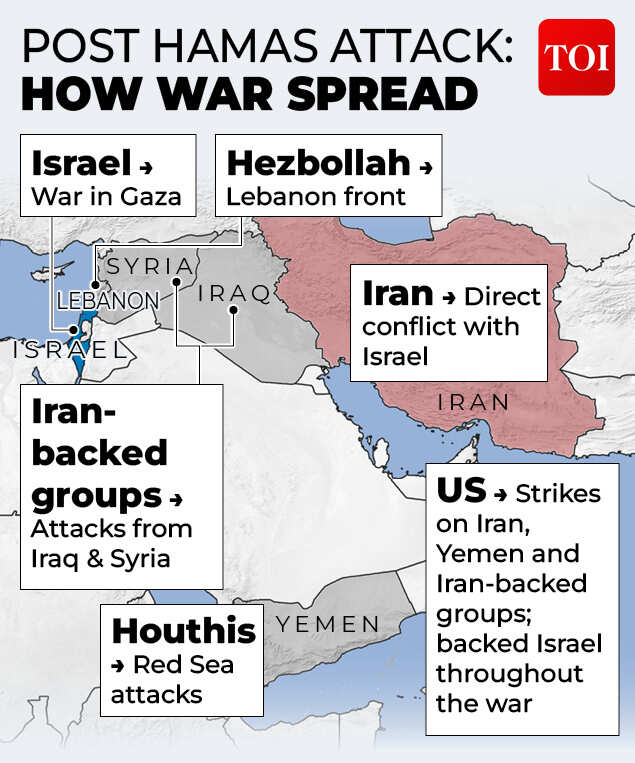
Three years of war have reshaped the balance of power across the Middle East
3 years on, Oct 7 is still reshaping map
The most consequential change may be that the region no longer has the same centre of gravity.Before October 7, Iran’s network of armed allies was at the height of its influence. Israel was powerful but largely operated within a familiar system of deterrence. Arab states were cautiously pursuing normalisation and economic integration. The Palestinian issue, while unresolved, had increasingly been pushed into the background of regional diplomacy.The attack shattered that equilibrium.Israel emerged more militarily dominant but also more isolated. Gaza emerged devastated. Iran’s regional network was badly weakened, but the collapse of that network created uncertainty rather than a settled alternative. Saudi Arabia and Turkey gained greater room to manoeuvre. Gulf states became more conscious of their own vulnerability. The US remained indispensable but its regional choices became more consequential — and more controversial.The result is not necessarily a new Middle East yet.It is a Middle East in transition.“This has changed the region forever,” Vaez told The Washington Post. “But with what consequences still has to play out.”And perhaps that is the clearest measure of what three years of war have changed.For an Israeli survivor, the smell of a barbecue can still bring October 7 back.For a child in Gaza, an airstrike can mean a missing parent, an injured body or another lost home.For Iran, Israel, Saudi Arabia, Turkey and the Gulf states, the same three years have rewritten calculations about power and security.The attack began with a breach in a border fence.Three years later, the breach has become a fault line running through the entire Middle East.
From Gaza’s ruins to a global shock
The deepest consequences of October 7 are still visible in Gaza, where three years of war have transformed everyday life. Homes, neighbourhoods and essential infrastructure have been devastated, while repeated displacement has uprooted much of the territory’s roughly two million people.The destruction has extended far beyond buildings. Gaza’s economy has been pushed into collapse, with 92% of economic establishments damaged or destroyed and unemployment reaching 78%, according to UN figures cited in September. Nearly 98% of schools have been damaged or destroyed, while Gaza’s health system has been left barely functioning. For many families, access to water, electricity, shelter, healthcare and education has become a daily struggle.The war has also reshaped the geography of Gaza. Israeli military control and restrictions have pushed Palestinians into increasingly smaller areas, while the so-called Yellow Line has become a new dividing point inside the territory. The result is a population living amid destroyed homes, damaged infrastructure and limited access to basic services, even after the October 2025 ceasefire.But the economic consequences did not remain confined to Gaza or the Middle East.The war disrupted energy markets and global supply chains, with the Strait of Hormuz emerging as a critical pressure point. Around 25-30% of global oil and about 20% of liquefied natural gas pass through the waterway, exposing major energy importers in Asia and Europe to higher fuel and power costs.Shipping disruptions have increased freight and insurance costs, while interruptions to fertiliser supplies have raised concerns over food prices. The shock is particularly severe for poorer countries, where food accounts for a larger share of household spending and governments have less fiscal space to absorb higher costs.Financial markets have also felt the effects, with higher borrowing costs, tighter financial conditions and increased volatility adding to pressures on economies already carrying heavy debt burdens.The IMF has described the shock as global but uneven: energy importers are more exposed than exporters, poorer countries more than richer ones, and economies with limited reserves more than those with stronger buffers.That may be the widest legacy of October 7. The attack began in southern Israel, but its consequences have travelled through Gaza’s ruins, across the region’s borders and into the world’s energy, food, trade and financial systems.Three years on, October 7 is no longer only a date that changed the Middle East. It has become a fault line whose economic and geopolitical aftershocks continue to reach far beyond it.