


- January 30, 2026
‘Om Shanti Shanti Shantihi’ movie review: Eesha Rebba, Tharun Bhascker shine in this sharp critique of patriarchy
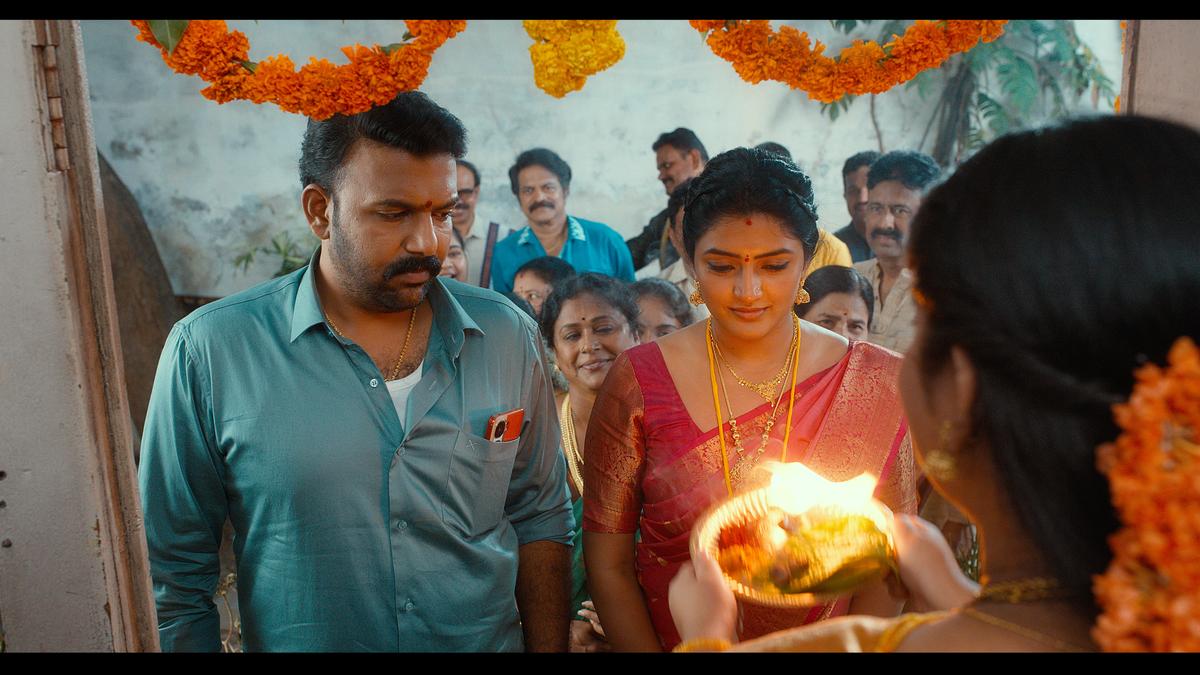
Tharun Bhascker, Eesha Rebba in ‘Om Shanti Shanti Shantihi’
| Photo Credit: Special Arrangement
The 2022 Malayalam film Jaya Jaya Jaya Hey was not subtle in its take on patriarchy, opting instead for an intentionally over-the-top reversal of power. In adapting the film into Telugu and relocating it to the Godavari region, director A.R. Sajeev stays largely faithful to the original. Om Shanti Shanti Shantihi is a partly fun, partly simmering emotional drama, shouldered by compelling performances from Eesha Rebba and Tharun Bhascker. While it does not always strike the right note, the film effectively captures the many ways patriarchy continues to stifle women, and how both men and women often enable it.
The childhood portions establish how the female protagonist is short-changed at every turn — in toys, books, clothes, and even something as simple as being denied the fruit of her choice — under the guise of others knowing what is best for her. Some character writing is especially sharp, notably the nosy, supposedly well-meaning uncle, a familiar figure who believes he has the right to dictate everything from a child’s education to her leisure.

Early on, when the girl’s father expresses a desire to raise her like the fearless Rani Lakshmibai, he is swiftly corrected by this uncle on what society would find acceptable. The father’s lack of resolve and the mother’s internalised patriarchy shape how Prashanti (Eesha Rebba) grows up. Nanda Kishore Emani’s dialogues not only root the film firmly in its regional dialect but also mirror everyday conversations with unsettling accuracy.
Om Shanti Shanti Shantihi (Telugu)
Director: A.R. Sajeev
Cast: Eesha Rebba, Tharun Bhascker, Brahmaji, Surabhi Prabhavati
Runtime: 131 minutes
Storyline: When a woman decides that she has had enough in a toxic marriage, she encounters resistance at multiple levels.
Om Shanti Shanti Shantihi begins lightly before steadily exposing layers of social hypocrisy. Writer Nanda Kishore Emani appears briefly as a professor whose lofty talk of women’s empowerment amounts to little more than lip service.
At the matchmaking meeting, Prashanti’s conversation with Omkar Naidu (Tharun Bhascker) barely moves beyond his fish business. The humour lies not just in his limited interests, but in how these seemingly throwaway remarks are cleverly used in the narrative later.
The sections set in Naidu’s home, as Shanti adjusts to life as a new bride, go beyond depicting his rage. They raise pointed contradictions. Is a man who insists on the same breakfast every day — idlis made only from stone-ground batter — an emblem of simple living, or merely intolerant of change? What role does his family, especially his mother, play in excusing his behaviour? The film resists easy binaries, urging viewers to read the subtext. Refusing dowry alone, it reminds us, is no green flag; an unchecked ego can make everyday life unbearable.

The narrative turns on the slap — a device long used by mainstream cinema to silence women — and reframes it as a catalyst for change. Viewers unfamiliar with the original will find the twist effective and a lot of fun, even if the shift feels abrupt rather than gradual. It is dramatic, but cathartic and whistleworthy.
In these portions, Vishnu Vardhan Pulla’s production design and Deepak’s cinematography create a convincingly lived-in world of a middle class home without drawing attention to themselves. For a film centred on a handful of characters, performance is its backbone.
Eesha Rebba delivers one of her most assured turns yet, balancing vulnerability with resolve. A dependable actor who has long been underappreciated, she handles both the lighter beats and emotional undercurrents with ease. Tharun Bhascker, shedding his usual affability, is striking as a man shaped by entitlement. Even when the momentum dips, the performances of these two actors help to stay invested in the drama. Brahmaji, Surabhi Prabhavati and the other actors add weight in well-judged supporting roles.

The latter portions stretch on, though the film’s exploration of male toxicity remains pointed. The finale, though buoyed by a dramatic score, delivers poetic justice.
In pushing back against the glut of alpha-male narratives in mainstream cinema, Om Shanti Shanti Shantihi makes its stance clear. When the protagonist asks whether she needs a man’s permission to study, work, or simply exist — right down to her choice of food — the question lands with uncomfortable force.
Published – January 30, 2026 03:42 pm IST


