- November 19, 2026
Complete data could've raised average Diwali pollution level in Delhi by 49%
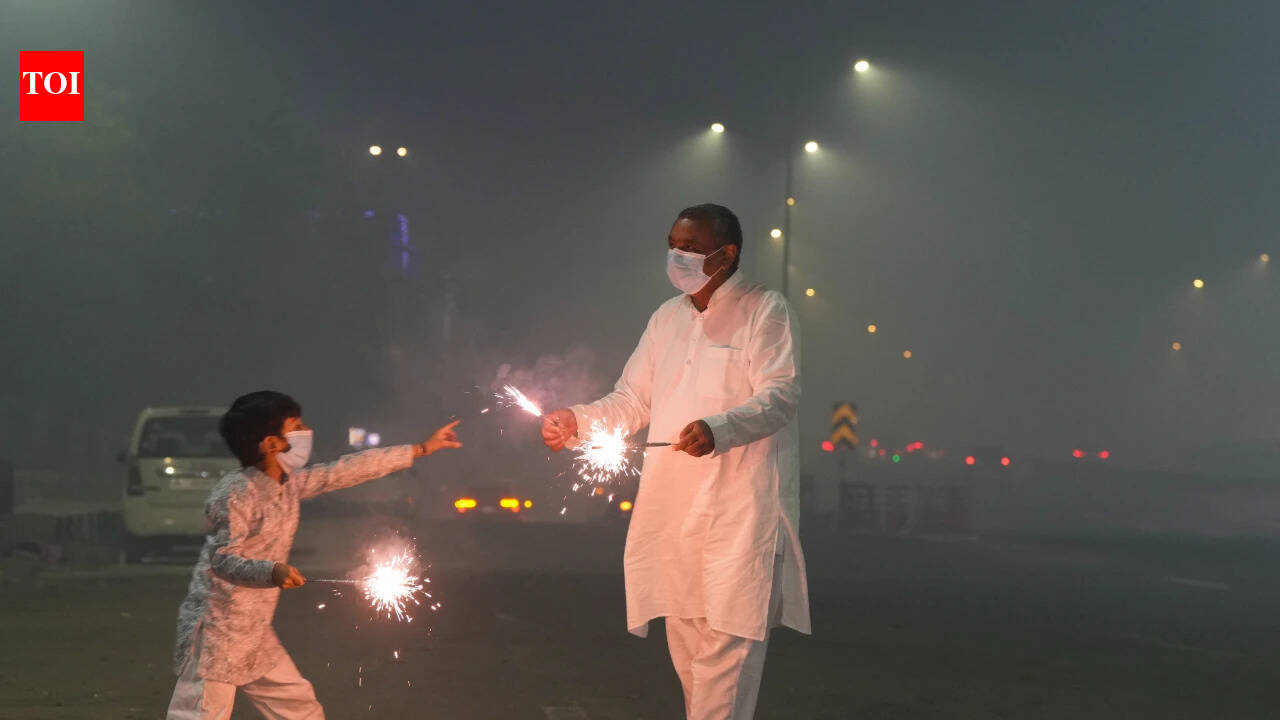
NEW DELHI: Missing PM2.5 data from monitoring stations could have raised the city’s average pollution level by 49% on Diwali, according to an analysis by Centre for Research on Energy and Clean Air (CREA).Had the missing readings been recorded at 1,000 micrograms per cubic metre (g/m³), the city’s average PM2.5 level would have increased from 269 to 400(g/m³), it revealed. The daily national ambient air quality standard for PM2.5 is 60 g/m³ and WHO’s safe guideline is 15 g/m³.The analysis was done a day after Central Pollution Control Board (CPCB) said its stations’ analysers were calibrated to measure particulate matter concentrations only up to 1,000g/m³ and could not display readings beyond it on Diwali night for several hours.Nor were these readings considered for calculating the average AQI, it said.CREA said if 400g/m³ had been considered, city’s AQI on Monday would have risen from 344 (very poor) to near severe. AQI is calculated based on 8 pollutants, including PM2.5.TOI reported Tuesday that CPCB had stopped giving data on particulate matter at the peak of Diwali night pollution for several hours after particulate matter levels at air quality monitoring stations surpassed 1,000g/m³.However, Delhi Pollution Control Committee (DPCC), which operates 43 of the total 60 stations, gave readings on Diwali night that crossed 1,000g/m³. At least at 11 locations, the hourly PM2.5 concentration was above 2,000g/m³. In four, it was above 3,000.CPCB compiles data from all 60 stations and releases the AQI. One station has been defunct for the past few months.The latest analysis examined hourly PM2.5 data from 59 monitoring stations between 4pm on Nov 8 and 4pm on Nov 9, corresponding to the 24-hour averaging period used for CPCB’s 4pm AQI bulletin on Nov 9. It analysed 1,416 hours (24 hours x 59 stations).It found that 255 of the 1,416 expected station-hour observations or 18% were missing. CREA conducted a sensitivity analysis by assigning them a value of 1,000g/m³, the upper measurement limit cited by CPCB for particulate matter. Under this scenario, the pooled average PM2.5 concentration across the expected observations increased from 269g/m³ to 400g/m³, a rise of 49%.
Be respectful · TOI community guidelines
“The peak PM2.5 levels of Delhi was 584 g/m³ at 1am on Nov 9 when there was missing data. However, after replacing the missing data with 1,000 g/m³, the peak PM2.5 concentration was 825 g/m³ at 2am and 824 g/m³ at 3am,” said CREA.It clarified that the sensitivity analysis does not establish that all 255 missing observations were caused by PM2.5 concentrations exceeding 1,000g/m³. Assigning the upper measurement limit to these observations was only an illustrative exercise to understand how the reported average could change under such a scenario.TOI reported Tuesday that hourly PM2.5 levels at Mundka touched 3,744g/m³ at 2am Monday, according to DPCC’s data. However, CPCB did not share Mundka’s PM2.5 readings from 12 midnight to 4 am.