- July 11, 2026
Sharath Kamal’s Big Asian Games Demand for Manav & Manush: ‘I Need That Medal’
Last Updated:
Sharath Kamal is “pressurising” Manav Thakkar and Manush Shah to win an Asian Games medal, aiming to overcome past near-misses.




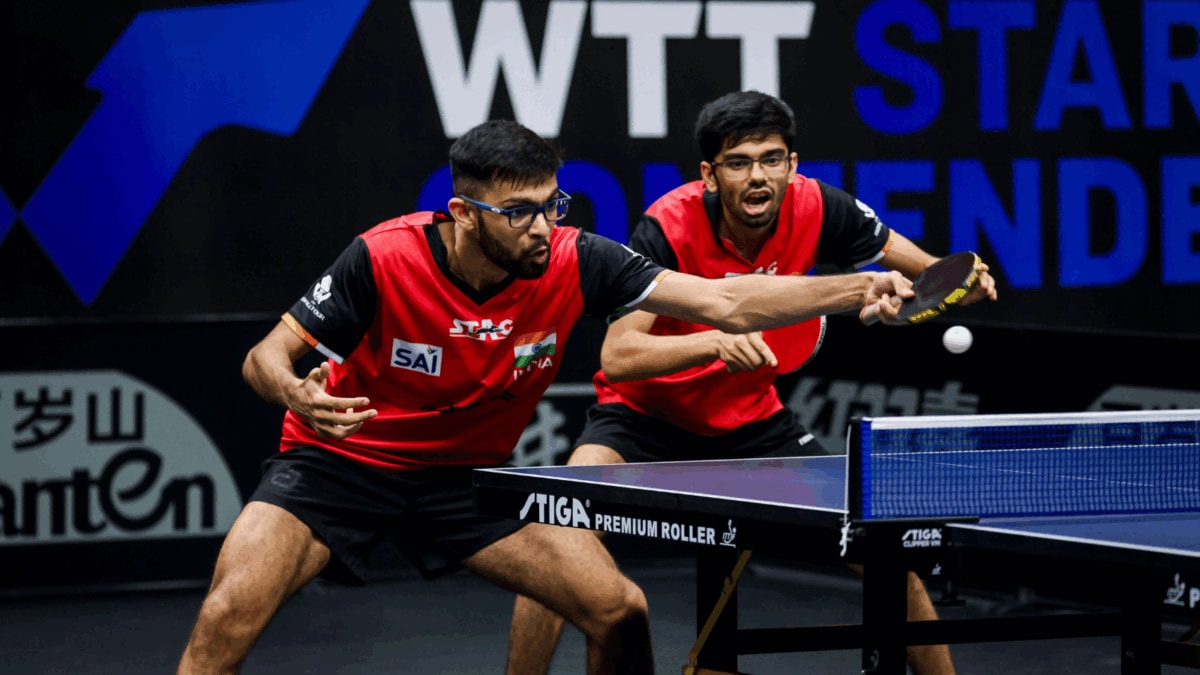
Manush Shah and Manav Thakkar (WTT)
Two-time Asian Games bronze medallist Sharath Kamal has said that he is ‘pressurising’ the star duo of Manav Thakkar and Manush Shah to win an Asian Games medal, adding that he ‘needs’ the coveted medal from them.
Manav and Manush were very close to sealing a medal at the Hangzhou Asian Games but lost in the quarterfinals to Korea’s Jang Woo-jin and Lim Jong-hoon.
This time, Sharath wants no mistakes from the duo and wants them to seal the medal. Indian paddlers have won three medals at the Asian Games, in men’s team, women’s doubles and mixed doubles events. A men’s doubles medal has remained elusive.
“I am already putting a bit of pressure on Manav and Manush because I want that Asian Games medal from them, especially in doubles. Last time, they were very close but couldn’t convert it,” Sharath said while speaking to News18 Sports on the sidelines of Ultimate Table Tennis Season 7.
“Now they are ranked World No. 3 and could even move up to No. 2 next week. They have been performing exceptionally well. I am doing this deliberately, so they get used to handling expectations well before the Asian Games,” Sharath added.
Sharath said that he wants Manav and Manush to think about the Asian Games now and work towards that goal well in advance so that, by the time the tournament arrives, the pressure feels familiar rather than overwhelming.
Having retired from competitive table tennis more than a year ago, Sharath has transitioned into coaching and administration. How has life after retirement been for him till now?
“It has been a smooth transition, and I am happy with how things have unfolded. I am glad I have been able to continue contributing to the sport. Even as a senior player, I was helping and guiding younger athletes, but now I am doing so in several capacities, as a coach, mentor and administrator,” Sharath said.
“I am also working with the Indian Olympic Association, collaborating with the Ministry of Youth Affairs and Sports, as well as the Tamil Nadu government. Overall, I am very satisfied with this new phase of my career and I hope to continue contributing to Indian sport in every way I can,” Sharath added.
While juggling several roles, what is the former paddler’s roadmap for contributing to the growth and development of table tennis in India?
“The roadmap is not defined yet because I am still figuring out where I can make the biggest impact. Right now, I am wearing multiple hats, and I see value in each role. Every position comes with its own strengths and limitations, so by taking on different responsibilities, I can minimise those limitations,” Sharath said.
“For instance, if I am a head coach or running an academy, my contribution is limited to the technical side of the sport. But policymaking and sports governance are important,” Sharath added.
The former Indian paddler said that the International Olympic Committee has been encouraging the Indian Olympic Association to strengthen governance, while the Ministry of Youth Affairs and Sports has been requesting national sports federations to improve transparency and accountability.
“That means ensuring robust selection criteria, well-planned competition calendars and, most importantly, creating an environment where athletes have the best possible experience and can perform at their highest level,” Sharath said.
The talk around selection led to Indian table tennis’ hottest topic right now, Manika Batra, being reduced to a reserve player in the Asian Games squad. The star paddler threatened legal action against the Table Tennis Federation of India for the same reason.
Does this chaos between the player and the federation affect the ones who have been selected already?
“Of course, it affects athletes when they don’t know whether they are going to be on the team. Initially, you may feel confident about your place, but if there is even a small element of doubt, ‘Will I make the team or not?’, it creates stress,” Sharath said.
“It puts all of us under some pressure. That is why good governance is so important. If you have clear rules in place and those rules are followed, then it does not become a problem,” Sharath added.
The Asian Games squad for the upcoming edition in Aichi-Nagoya sees a usual mixture of experienced and rookies, with the likes of G Sathiyan and Sutirtha Mukherjee sharing space with Payas Jain and Syndrela Das. How does Sharath look at this balance?
“It has always been like that. Even when I was playing as one of the senior members of the team, we always had young players coming through. In 2018, we had Manav in the squad when he was around 18 years old,” Sharath said.
“Later, on the women’s side, we saw youngsters like Diya Chitale coming into the setup. A successful team should always have a healthy mix of experienced players and young talent,” Sharath added.
The former player said that experience is invaluable when it comes to handling pressure, while younger paddlers bring fresh energy, enthusiasm and the hunger to push the team forward.
“A lot of the responsibility lies with the coach to manage that balance and ensure every player understands their role within the team. Players should not feel that someone else is taking away their place,” Sharath said.
“If the coach can clearly define each individual’s role, everyone can focus on doing their job, and that is when the team is most likely to achieve good results,” Sharath added.
Goa, India, India
Read More