- June 22, 2026
The Indus Waters Treaty Survived Wars. Here’s Why Khawaja Asif Says Water Could Trigger One Now
Last Updated:
What India can do is progressively utilise a larger share of water that the treaty already permits it to use, while accelerating projects that had previously moved slowly




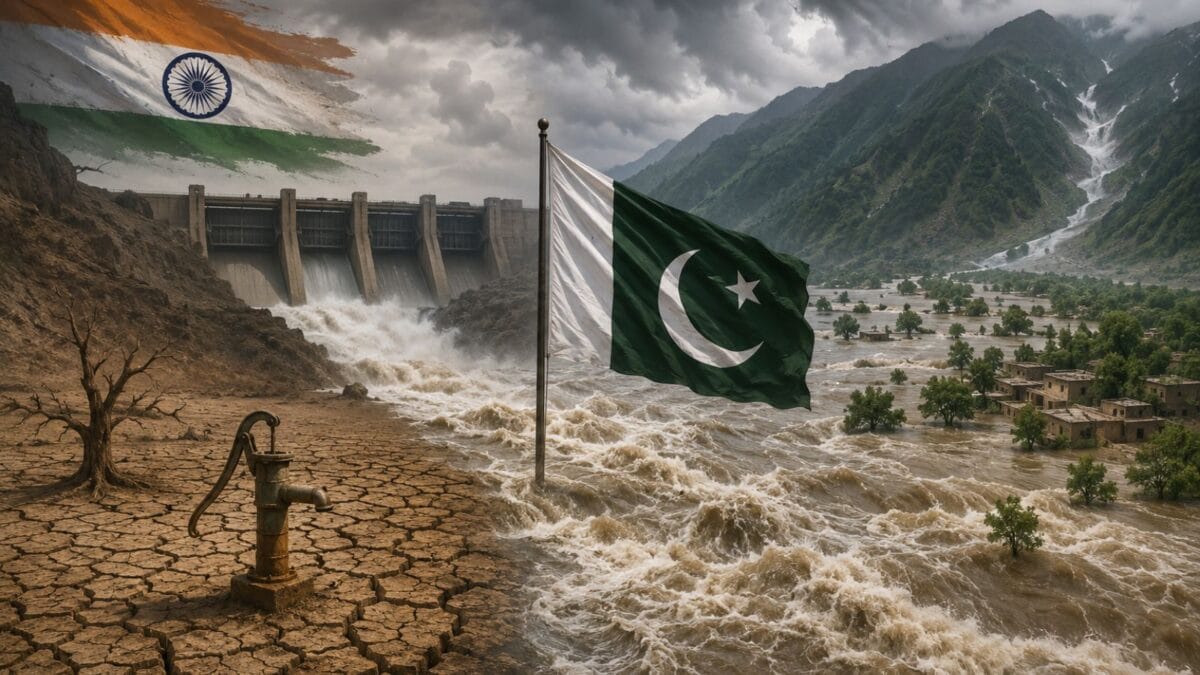
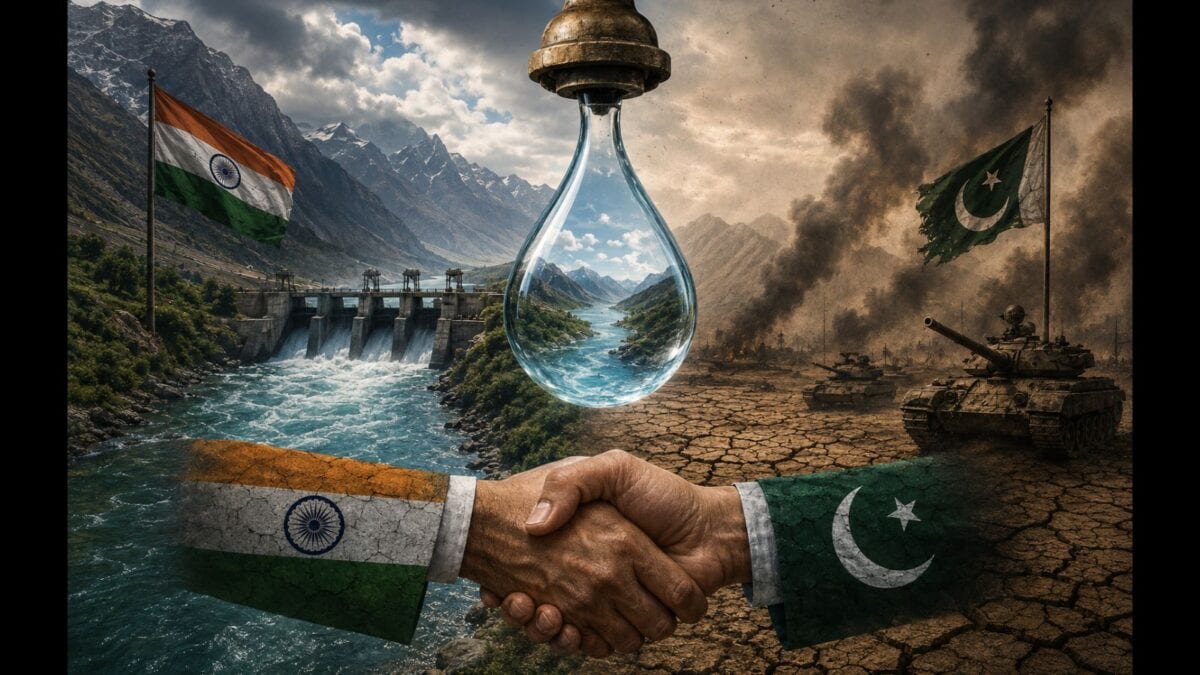
Under the treaty, Pakistan received near-exclusive rights over the three western rivers—the Indus, Jhelum and Chenab. India retained rights over the eastern rivers—Ravi, Beas and Sutlej. (AI-Generated Image)
Pakistan is at it again. The country’s defence minister Khawaja Asif, in yet another attempt to needle India, has warned that Islamabad could resort to military action if it believes the country’s water security is under serious threat. The threat comes amid escalating tensions following New Delhi’s suspension of the Indus Waters Treaty.
“The moment we feel that our national security and water are being threatened, we will go to war against India. Definitely,” Asif said, while speaking to ARY News.
The statement has brought back attention to the Indus Waters Treaty (IWT) which, for more than six decades, was often described as one of the world’s most successful water-sharing agreements. It survived multiple India-Pakistan wars, military crises and prolonged diplomatic breakdowns. Even when bilateral relations collapsed, the treaty endured.
ALSO READ | Facing Indus Waters Treaty Fallout, Bilawal Bhutto Threatens India In Pakistan Parliament: ‘We’ll Retaliate’
However, all that changed after the April 2025 terror attack in Pahalgam, which killed 26 people. In its aftermath, India announced that it was placing the treaty “in abeyance” until Pakistan took credible and irreversible action against cross-border terrorism. The decision marked the most serious challenge to the treaty since it was signed in 1960.
The move has triggered a wider debate: What was the treaty designed to achieve? Why does India now consider it outdated? And what could the consequences be for Pakistan?
A Treaty Born Out Of Partition
The origins of the Indus Waters Treaty lie in the chaos of Partition.
When British India was divided in 1947, the six rivers of the Indus basin suddenly flowed across two newly created countries. While many of the rivers originated in India, large irrigation networks built during British rule were located in what became Pakistan.
The problem surfaced almost immediately. In April 1948, India temporarily stopped water flows from some canals serving Pakistan, highlighting how vulnerable the new country was to upstream decisions. The dispute soon escalated into one of the first major India-Pakistan disagreements after Partition.
ALSO READ | India Launches Two Major Chenab Projects Amid Indus Treaty Freeze | Exclusive
The negotiations stretched for years before the World Bank stepped in as a mediator. The eventual solution involved dividing the river system rather than sharing individual rivers. This became the foundation of the treaty signed by Indian Prime Minister Jawaharlal Nehru and Pakistani President Ayub Khan in Karachi on September 19, 1960.
How The Treaty Works
The treaty divided the six rivers of the Indus basin into two groups.
Pakistan received near-exclusive rights over the three western rivers—the Indus, Jhelum and Chenab. India retained rights over the eastern rivers—Ravi, Beas and Sutlej.
This allocation was unusually generous from an upstream perspective. Various official and academic assessments note that nearly 80 per cent of the basin’s waters were effectively assigned to Pakistan, while India received control over the eastern rivers.
India was allowed limited use of the western rivers for domestic consumption, irrigation and run-of-the-river hydropower projects, but significant restrictions were placed on storage and diversion.
The arrangement ensured predictable water flows to Pakistan’s vast agricultural economy, particularly in Punjab and Sindh, where millions of farmers depend on irrigation from the Indus system.
Why The Treaty Was Considered Exceptional
The treaty’s reputation rests largely on its durability. It survived the wars of 1965, 1971 and 1999, as well as decades of diplomatic hostility. Even after major terrorist attacks such as Mumbai in 2008 and Pulwama in 2019, neither side formally abandoned the agreement.
The treaty also created a permanent institutional mechanism through the Permanent Indus Commission, allowing technical discussions to continue even when political dialogue had broken down.
Why India Began Seeking Changes
India’s dissatisfaction with the treaty began much before the Pahalgam attack.
New Delhi has increasingly argued that the agreement was drafted under very different circumstances and does not adequately account for present-day realities such as climate change, changing water requirements, clean-energy needs and population growth.
At the UN Human Rights Council this month, India described the treaty as “outdated” and criticised Pakistan for repeatedly obstructing permitted Indian hydropower projects through legal and arbitration processes.
Indian officials have argued that Pakistan has used dispute-resolution provisions in ways that delay infrastructure projects rather than resolve technical disagreements. New Delhi has also maintained that it has never fully utilised the rights available to it under the treaty.
In January 2023, India formally notified Pakistan that it wanted modifications to the agreement. A second notice followed in 2024, signalling growing frustration with the treaty’s existing framework.
How Pahalgam Changed The Equation
The April 2025 attack transformed a long-running policy debate into a national-security issue.
Following the attack, India announced that the treaty would be held in abeyance until Pakistan ended support for cross-border terrorism. The decision was part of a broader package of measures that linked bilateral engagement directly to security concerns.
The government’s argument was straightforward: a treaty built on cooperation and goodwill cannot function normally if one side believes it is facing sustained terrorist threats originating from the other.
What Does ‘In Abeyance’ Actually Mean?
Contrary to some public perceptions, India has not physically stopped the rivers from flowing into Pakistan.
The geography of the basin makes an immediate cutoff impossible. Existing infrastructure does not allow India to suddenly divert or store the enormous volumes of water carried by the western rivers.
Instead, the practical implications are more gradual. By suspending cooperation mechanisms, India is no longer treating treaty obligations as fully operational. Officials have suggested that India will move more aggressively to maximise its rights over western-river waters through infrastructure development, storage projects and hydropower facilities.
Why Pakistan Is Worried
Pakistan’s concerns stem from its extraordinary dependence on the Indus basin.
ALSO READ | IWT Paused, Infra Fast-Tracked, Pakistan Irked: A Look At India’s Projects On Chenab
Agriculture contributes significantly to the country’s economy and relies heavily on irrigation supplied by the Indus river system. Large parts of Pakistan’s food production, rural employment and water security are linked directly to these rivers.
Experts frequently describe Pakistan as one of the world’s most water-stressed countries. Any reduction in flows, even gradual or seasonal, can have economic consequences.
For Islamabad, therefore, the issue extends beyond diplomacy. It touches food security, electricity generation, irrigation planning and long-term economic stability.
This explains why Pakistani officials have reacted strongly to India’s latest position, characterising it as a potential “water war” and warning about broader regional consequences.
Can India Actually Stop The Water?
Not in the short term.
Most experts agree that India currently lacks the storage capacity needed to halt flows on a large scale. Building reservoirs, diversion structures and associated infrastructure would take years and require substantial investment.
What India can do is progressively utilise a larger share of water that the treaty already permits it to use, while accelerating projects that had previously moved slowly. Over time, that could reduce the volume of water reaching Pakistan during certain periods and increase India’s leverage as the upstream state.
Irrespective of the change in modalities, what is clear is that a water-sharing agreement once celebrated as untouchable has entered its most consequential phase since 1960.
About the Author

Apoorva Misra is a News Editor at News18.com with a keen interest in politics and current affairs. She loves uncovering fresh angles and telling stories through long-form features and explainers. Foll…Read More
Read More