- August 21, 2026
Donald Trump And ‘Sanewashing’: When The Media Cleans Up The Chaos
Last Updated:
In simple terms, sanewashing is when unusual, extreme, incoherent or controversial political statements are repackaged in language that makes them sound more coherent or reasonable




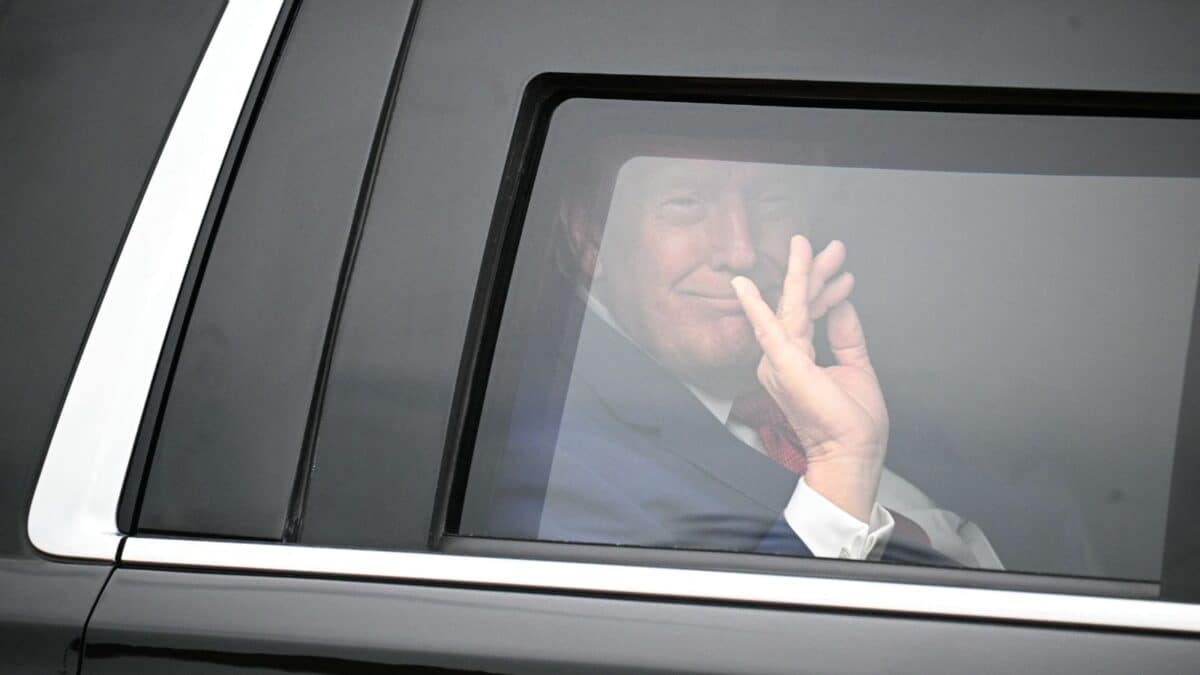
US President Donald Trump. (AFP)
Donald Trump has always presented a peculiar challenge for political journalism—What do you do when the most newsworthy part of a politician’s statement is that it makes little sense?
The question is particularly relevant now. On Wednesday, Trump was asked about the possibility of restarting negotiations with Iran. He said talks could resume “maybe at some point”, but added: “Right now, I think the situation is so good.” He also claimed that the United States had “complete control” of the Strait of Hormuz, even as the war and the disruption of shipping through the waterway continued.
The straightforward headline could be: Trump leaves door open to renewed Iran talks. That is accurate. But what happens when the process of turning a rambling, contradictory or bizarre statement into a clean news line removes precisely the part that tells readers something important about what the politician actually said?
That is the question behind a term increasingly used to describe coverage of Trump: Sanewashing.
What Is Sanewashing?
In simple terms, sanewashing is when unusual, extreme, incoherent or controversial political statements are repackaged in language that makes them sound more conventional, coherent or reasonable.
ALSO READ | ‘Will Correct The Delusions Of This Deluded Man’: Iran Fires Back At Trump Over Hormuz Claim
Poynter defines it as “packaging radical and outrageous statements in a way that makes them seem normal”. The term borrows from concepts such as greenwashing and sportswashing, where presentation is used to soften or obscure something about the underlying reality.
Applied to Trump, the accusation is that journalists sometimes take the coherent portion of a speech or answer, report that as the main story and leave the reader with little sense of how strange, contradictory or incoherent the original remarks were.
That does not necessarily mean journalists are deliberately trying to make Trump look better. And new academic research into the phenomenon suggests the reality is considerably more complicated.
The Iran Example: ‘The Situation Is So Good’
Trump’s August 19 comments provide a useful contemporary example of the debate.
Asked whether the US would return to negotiations with Iran, Trump said: “Maybe at some point. But right now, I think the situation is so good.” He also said the US had “complete control” of the Strait of Hormuz while acknowledging that Iranian drone attacks had some “nuisance value.”
A conventional news story could reasonably frame this as Trump leaving open the possibility of renewed negotiations with Iran.
But the fuller answer matters. The remarks came against the backdrop of a six-month conflict, a continuing crisis around Hormuz and stalled diplomatic efforts. Reuters reported on Thursday that Trump’s Iran policy was facing stalled progress and mixed messages over negotiations.
The Trump Childcare Example
The clearest academic case comes from September 2024.
At the Economic Club of New York, Trump was asked what he would do to make childcare more affordable if he returned to the White House. His response ran for roughly two minutes and contained hundreds of words, moving between childcare, tariffs, taxes, deficits, foreign countries and other subjects.
Researchers Stephen Harrington, Ella Chorazy and Timothy Graham of Queensland University of Technology described it as a 374-word response that failed to directly answer the question.
Yet subsequent coverage focused heavily on a more conventional policy proposal Trump had discussed during the same appearance: an efficiency commission associated with Elon Musk.
The New York Times, for example, ran the headline: “Trump calls for an efficiency commission, an idea pushed by Elon Musk.” The QUT researchers noted that the newspaper referred to Trump’s “jumbled and meandering answer” on childcare only much later in the article.
The problem wasn’t that the efficiency commission story was false. It was that a reader who only saw the headline could come away with a substantially more orderly impression of Trump’s appearance than someone who watched the exchange itself.
Another Test: Arnold Palmer
The QUT researchers examined a second Trump speech; a rally in Latrobe, Pennsylvania, where Trump made an off-colour remark about golfer Arnold Palmer.
This time, the coverage was different.
The researchers analysed the speech alongside hundreds of news articles from traditional newspapers and online outlets. Their findings showed that journalists were more likely to discuss the Palmer remarks than the bizarre childcare answer had been covered in the earlier case.
That matters because it complicates the argument that the media simply sanitises everything Trump says.
So, Is The Media Actually Sanewashing Trump?
Sometimes, but not consistently.
The 2026 QUT research found evidence of sanewashing around the two Trump speeches it examined. Journalists generally focused on one or two major themes from his remarks and often described those themes using language substantially different from Trump’s own words.
But the researchers also found that the phenomenon was not uniform.
Coverage of Trump’s economic speech tended to focus on conventional themes such as taxation and government spending while overlooking the childcare answer. Coverage of the Arnold Palmer rally was more likely to focus on the controversial remark itself.
There was another difference: online outlets were more likely to use words such as “weird” and “bizarre”, while traditional outlets more often used relatively neutral descriptions such as “meandering” and “erratic.”
So, the research does not establish a simple conspiracy in which mainstream journalists deliberately make Trump sound sane. Instead, it points towards something more mundane and potentially more consequential.
Journalism Is An Exercise In Selection
Poynter’s Kelly McBride argues that journalists naturally try to make complicated information understandable. The problem arises when the effort to clarify something removes information that is itself essential to understanding it.
A reporter doesn’t have to reproduce every tangent or verbal stumble. But if a politician spends two minutes giving a rambling answer to a direct question and the article makes it appear that they delivered a clear policy response, something has been lost.
Consider two possible headlines about the same event:
“Trump proposes X policy to address childcare costs.”
Versus:
“Trump gives rambling response on childcare, shifting to tariffs and other issues.”
Neither headline necessarily contains a factual error. But they give the reader very different pictures of what happened.
That is the heart of the sanewashing debate. The issue isn’t necessarily that the media is lying. It is that a technically accurate description can still be misleading if it removes the context that changes the meaning of the event.
Trump Has Created A Particularly Difficult Problem
Trump’s political style makes this challenge unusually acute.
Traditional political journalism generally assumes that politicians will make arguments, announce policies and respond to questions in relatively coherent ways.
Trump frequently jumps between subjects, repeats claims, improvises and makes statements that are difficult to fit into conventional political language.
The Associated Press noted during the 2024 campaign that journalists were struggling with how much of Trump’s rallies to broadcast, how aggressively to fact-check him and how to handle statements that were simultaneously outrageous and increasingly routine.
That created another phenomenon sometimes called the “banality of crazy”. The idea is simple: when a politician says something outrageous often enough, it can stop feeling outrageous.
A statement that would once have dominated coverage can become just another line in a long speech. And once the unusual becomes routine, journalists may devote less attention to the unusualness itself.
The Problem Of ‘Normalising’ The Abnormal
This is where sanewashing overlaps with another concern: normalisation.
Suppose Trump makes an extraordinary statement and the resulting news report translates it into the language of ordinary politics.
The reader gets the policy. But the reader may not get the political reality surrounding the policy.
That distinction matters particularly when voters are assessing not just what a candidate proposes, but how the candidate thinks, communicates and responds to questions.
During the 2024 campaign, this debate became particularly intense because Joe Biden was facing extraordinary scrutiny over his age and cognitive fitness before withdrawing from the presidential race.
Critics argued that Trump was being subjected to a different standard: his verbal oddities were being treated as familiar Trump behaviour rather than evidence voters might reasonably consider when assessing his fitness for office.
But there is a danger in the opposite direction too. If journalists obsess over every bizarre Trump remark, they could turn political journalism into a running catalogue of oddities while overlooking substantive policy.
The QUT researchers themselves stress this tension: journalists should draw attention to unusual or incoherent remarks without allowing them to obscure important policy decisions.
Key Questions Answered
 Ask News18
When the media normalises unusual statements, journalists may pay less attention to the unusualness of those statements over time.
Ask News18About the Author

Apoorva Misra is an Associate Editor at News18.com with a keen interest in politics and current affairs. She loves uncovering fresh angles and telling stories through long-form features and explainers…Read More
New York, United States of America (USA)
August 21, 2026, 15:12 IST
Read More