- August 7, 2026
Saudi Arabia, Turkey, Pakistan Sign Landmark Defence Pact: What the Makkah Joint Defence Agreement Means
Last Updated:
Decoding what Mecca defence agreement means for Gulf: It establishes a NATO-like clause: an armed attack against any one will be regarded as an attack against them all




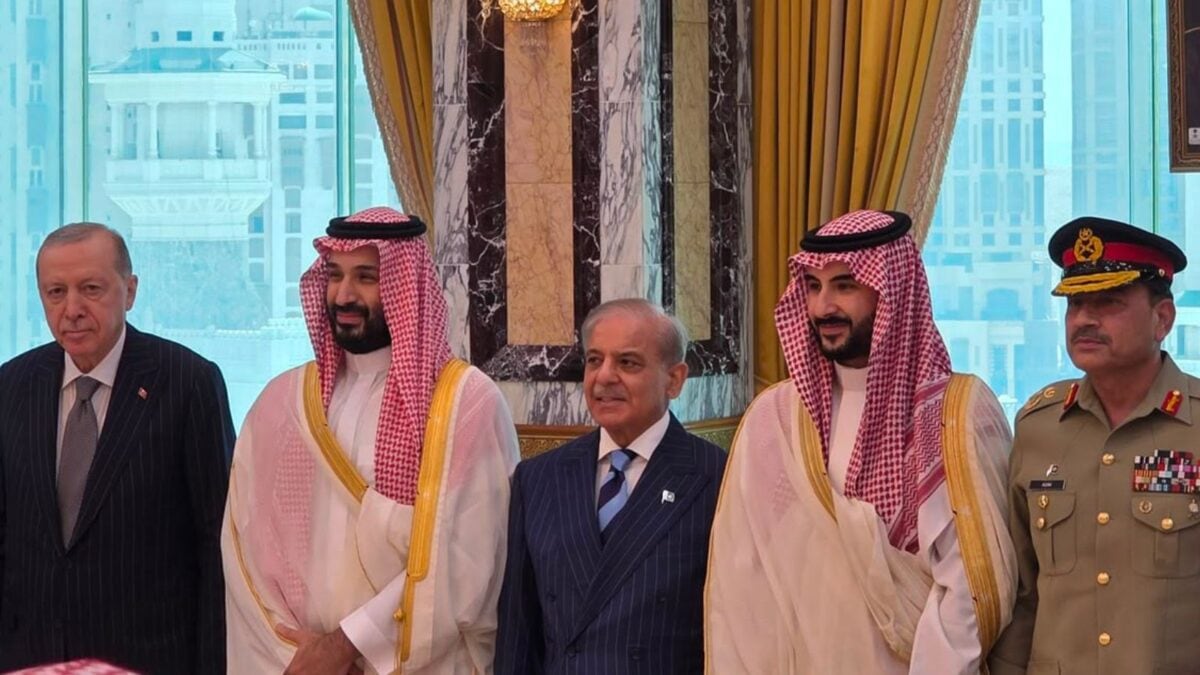
The leaders at the signing of the pact.
Saudi Arabia, Turkey, and Pakistan on Friday inked a historic trilateral defense agreement known as the Mecca or Makkah Joint Defence Agreement. Signed in the holy city of Mecca by Saudi Crown Prince Mohammed bin Salman, Turkish President Recep Tayyip Erdogan, and Pakistani Prime Minister Shehbaz Sharif, the core of the treaty establishes a NATO-like collective defense clause: an armed attack against any one of the three states will be regarded as an attack against them all.
The agreement marks a monumental shift in the geopolitical landscape of the Middle East and South Asia.
WHAT THE AGREEMENT ENTAILS
Collective Deterrence: A binding commitment to provide mutual military support if any member faces external armed aggression.
Intelligence Sharing: Streamlining deep security and intelligence cooperation to keep all three nations “in tune” during regional crises.
Industrial & Energy Defence Cooperation: Setting a roadmap for joint defence manufacturing, defence expenditure coordination, and energy security.
WHAT EACH COUNTRY BEGINS
The agreement combines the unique and highly formidable strengths of three of the largest militaries and economies in the Muslim world:
Saudi Arabia: Mass financial power, vast energy capital, and massive technological spending capabilities.
Turkey: Advanced defense manufacturing infrastructure (e.g., combat-proven drones, aviation tech) and NATO’s second-largest military force.
Pakistan: Nuclear weapons capability, robust missile technology, and a massive standing army with decades of experience training Gulf forces.
WHAT THE AGREEMENT MEANS FOR THE REGION
For decades, Gulf security — particularly Saudi Arabia’s — relied heavily on the United States. Amid protracted regional turmoil, including the U.S.–Iran war and the Gaza crisis, confidence in the traditional Western security order has severely eroded. This pact allows Riyadh to significantly diversify its security umbrella away from Washington.
The alignment is heavily viewed by geopolitical analysts as a direct response to revolutionary Iran’s aggressive stance and regional dominance. Because Turkey and Pakistan both share direct land borders with Iran, they exercise a unique strategic leverage that expands Saudi Arabia’s security cushion against Iranian-backed proxies like the Houthis.
Saudi Arabia aims to build a localized defense industry rather than just importing expensive Western weapons. By linking up with Turkey’s highly capable defense firms and Pakistan’s aerospace and missile sectors, the alliance will facilitate rapid technology transfers and co-production.
Pakistan swaps its military and nuclear deterrence capabilities for critical Saudi financial backing, capital investments, and energy concessions. Meanwhile, Turkey gains massive contracts for its defense sector and secures significant diplomatic and economic clout across the Gulf.
About the Author

At the news desk for 20 years, the story of her life has revolved around finding pun, facts while reporting, on radio, heading a daily newspaper desk, teaching mass media students to now editing speci…Read More
August 07, 2026, 19:54 IST
Read More