


- May 14, 2026
Neither Soft Nor Hawkish: Reading The Real Message Behind RSS Leader Hosabale’s Pakistan Remarks
Last Updated:
Senior functionaries of the Rashtriya Swayamsevak Sangh say Hosabale’s comments are not “rooted in political positioning, but in Bharat’s civilisational ethos”




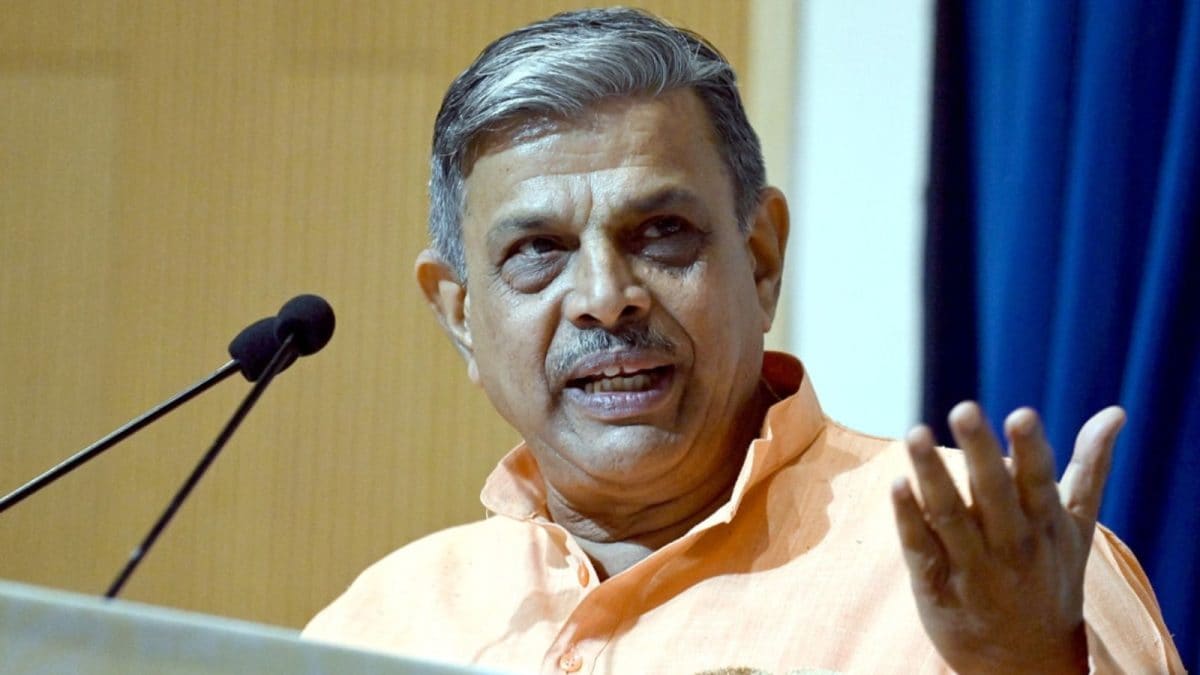
RSS General Secretary Dattatreya Hosabale said India should always be ready to engage in dialogue.
For nearly a decade, India’s public discourse on Pakistan has been dominated by the language of retaliation, deterrence and isolation. After the Pulwama and Pahalgam terror attacks, political signalling became uncompromising as Prime Minister Narendra Modi iterated that terror and talks cannot go together.
This is exactly why RSS General Secretary Dattatreya Hosabale saying India should keep ‘a window for dialogue’ with Pakistan has triggered immediate political curiosity. However, senior functionaries of the Rashtriya Swayamsevak Sangh (RSS) say Hosabale’s comments are not “rooted in political positioning, but in Bharat’s civilisational ethos”.
In an interview to PTI, Hosabale said, “…If Pakistan is like a pinprick trying to create incidents like Pulwama, etc., we have to answer appropriately according to the situation because the security and self-respect of a country and nation have to be protected, and the government of the day should take note of it and take care of it. But at the same time, we should not close the doors. We should always be ready to engage in dialogue…”
At first glance, the statement appears softer than the BJP’s muscular public posture. But a closer reading suggests something more layered is unfolding within the Sangh ecosystem—not a reversal of nationalism, but an attempt to distinguish between strategic firmness and permanent hostility.
Explaining the broader thinking behind Hosabale’s remarks on Pakistan, a senior RSS functionary said: “The root of the thought is not political positioning but India’s civilisational ethos. Bharat has always believed that while national security and territorial integrity are non-negotiable, permanent hostility between people should never become the only framework of engagement.” The functionary stressed that there can be “absolutely no compromise” when it comes to terrorism, national unity and sovereignty. “If Pakistan sponsors or enables terror incidents, the Army and the government must respond with full force according to the situation. Security response has to remain uncompromising,” he added.
Hosabale was careful in constructing that distinction. He made it clear that attacks like Pulwama require a strong response and that India’s sovereignty and national self-respect cannot be compromised. Yet, in the same breath, he argued against shutting down diplomacy, trade, visas or even sporting interactions completely. According to him, nations must preserve channels of communication even during periods of distrust. This is precisely where the nuance lies. The statement is not advocating appeasement. It is arguing that engagement and toughness are not mutually exclusive. “India engages with countries across conflict lines globally. Nations maintain ties with both Israel and Palestine, with Iran and UAE simultaneously. Dialogue and deterrence can coexist,” added the senior functionary.
The Sangh’s Civilisational Argument
The RSS has often viewed India not merely as a modern nation-state, but as a civilisational power. That distinction matters. A civilisation-state does not see dialogue as weakness; instead, it sees dialogue as confidence. Over the years, RSS chief Mohan Bhagwat—often invoking Gita, Ramayana and Mahabharat—has repeatedly described India as a peace-loving civilisation that prefers harmony, but is fully capable of defending itself when provoked. Hosabale’s comments fit into that broader ideological frame.
“There can be absolutely no compromise on India’s national security, unity and integrity. Any terror attack or attempt to destabilise the country must be answered with full force by the Army and the government. But simultaneously, India as a civilisation has never believed in permanent enmity between people. The thought behind continuing diplomatic or people-to-people engagement with Pakistan is not political softness. It comes from Bharat’s civilisational ethos. India can speak to different sides simultaneously, just as India engages with both Israel and Palestine, or maintain ties with both Iran and UAE, while remaining fully firm on terrorism,” said another senior RSS functionary.
This is also why comparing the remarks directly with day-to-day political messaging of the BJP can be misleading, the RSS functionaries added. Governments operate in the language of tactical response and electoral optics. The RSS often speaks in the language of long-term societal positioning. The two overlap, but they are not always identical in tone. In fact, the comments sound closer to the older Vajpayee school of strategic realism—respond firmly to terror, but avoid turning hostility into doctrine. India under Vajpayee fought Kargil, mobilised troops after the Parliament attack, yet continued speaking about engagement with Pakistan’s people.
“Atal Bihari Vajpayee also attempted dialogue with Pakistan despite difficult circumstances. Kargil happened afterwards, and the response was strong. History teaches us that security preparedness and diplomatic engagement are not contradictions. Final decisions, however, must always depend on the government and the geopolitical situation of the time,” said the functionary.
Hosabale’s emphasis on continuing sporting and civilian exchanges reflects a similar thinking. The underlying message appears to be that India should remain militarily uncompromising without becoming diplomatically closed.
The larger shift, therefore, is not ideological moderation. It is the re-emergence of a calibrated Sangh position which stated that a strong India should be capable of both retaliation and conversation at the same time.
Read More


