- May 8, 2026
Tamil Nadu Political Crisis Puts Spotlight On Sarkaria Commission; Here’s What It Recommended
Last Updated:
Sarkaria Commission’s mandate was to examine the relationship between the Centre and the states and recommend ways to reduce friction within India’s federal structure.




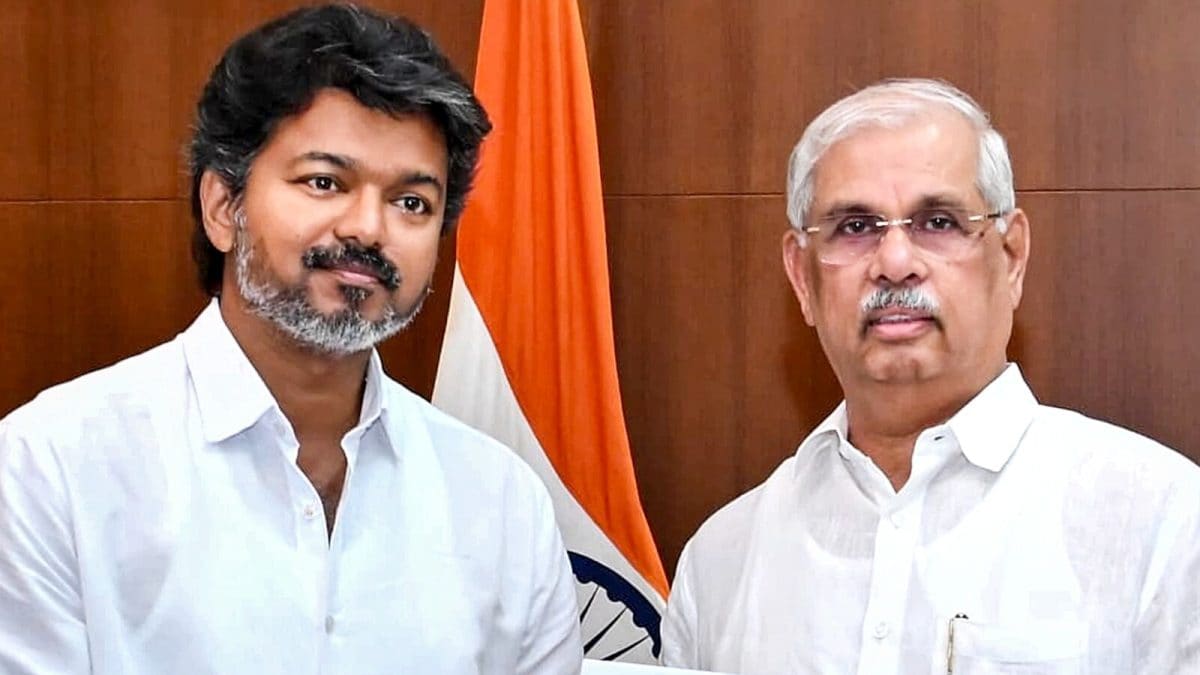
Tamil Nadu Governor Rajendra Arlekar with Tamilaga Vettri Kazhagam (TVK) chief Vijay during a meeting, at Lok Bhavan, in Chennai. Image/PTI
As the deadlock over government formation in Tamil Nadu deepens, an old constitutional document from the 1980s has suddenly returned to the centre of India’s political conversation: the Sarkaria Commission. What was once considered a dry administrative report is now being invoked by opposition parties, constitutional experts and legal commentators amid the dramatic tussle over government formation in the state.
The immediate trigger is Governor Rajendra Vishwanath Arlekar sending back TVK chief Vijay twice despite the party staking claim to form the government as the single largest party in the Assembly.
Read More: Vijay Would Have Been TN CM By Now If He Had Not Ignored This Advice: What Was His Mistake?
The move has sparked sharp criticism from the Congress, which has accused the Governor of acting beyond constitutional conventions and attempting to buy time for a possible alternative political arrangement.
Check Live updates on Tamil Nadu government formation here
Congress MP Manickam Tagore launched a direct attack on the Governor, accusing him of functioning at the behest of the BJP leadership at the Centre. “The governor should stop working on the behest of Amit Shah and Modi. What he is doing is constitutionally wrong. Governor delaying the claim by TVK is not going to help BJP in anyway,” Tagore said.
He further alleged that the BJP was trying to facilitate an unlikely post-poll understanding between the Dravida Munnetra Kazhagam and the All India Anna Dravida Munnetra Kazhagam. “BJP has come up with Tamil Nadu 2.0 plan to make an alliance between DMK and AIADMK that will not work. With just 1 MLA BJP thinks they can rule Tamil Nadu,” he said.
Similar criticism came from Congress leaders in Telangana as well, who accused Governor Rajendra Vishwanath Arlekar of behaving like an “extra-constitutional authority”. Telangana Congress leader B Mahesh Kumar Goud said the Sarkaria Commission recommendations and the Supreme Court judgment in the SR Bommai vs Union of India case stated that the single largest party should be invited to form the government.
What Was The Sarkaria Commission?
The Sarkaria Commission was set up in 1983 by the Union government under former Supreme Court judge Justice Ranjit Singh Sarkaria. Its mandate was to examine the relationship between the Centre and the states and recommend ways to reduce friction within India’s federal structure.
The timing was politically significant. During the 1970s and early 1980s, several opposition-ruled state governments accused the Centre of misusing Governors and constitutional provisions such as Article 356 to destabilise elected governments. Governors, in particular, were increasingly seen as political appointees who could influence power struggles in states.
The commission spent years studying constitutional disputes, administrative practices and Centre-state conflicts before submitting its report in 1988.
Even decades later, many of its recommendations continue to shape constitutional practice in India.
Why Is It Relevant In Tamil Nadu Today?
The current Tamil Nadu crisis revolves around a question the commission specifically tried to address: Who should get the first invitation to form the government in a hung Assembly?
TVK argues that as the single largest party, it deserves the first opportunity to prove majority on the floor of the House.
But speculation over a possible DMK-AIADMK understanding has complicated matters. If rival parties together claim majority support, the Governor could potentially argue that a coalition with numbers should get preference.
This grey area is exactly why the Sarkaria Commission framed guidelines for Governors.
What Did The Commission Recommend?
The commission proposed an order of preference for Governors when no party secures a clear majority.
It broadly suggested that Governors should first invite:
- A pre-poll alliance with majority support
- The single largest party with support from others
- A post-election coalition where partners formally join government
- A post-poll arrangement with outside support
The key principle behind these recommendations was that Governors should avoid arbitrary or politically motivated decisions.
The commission also stressed that the real test of majority should happen on the floor of the Assembly, not through subjective political assessments behind closed doors.
Why Congress Is Invoking Sarkaria
By citing the Sarkaria Commission, Congress is effectively arguing that the Governor should not indefinitely delay inviting the single largest party if it is prepared to demonstrate support in the House.
The opposition’s concern appears to be that delays could create space for political realignments or defections before a floor test takes place.
This is why the Governor’s repeated decision to send TVK back has triggered accusations of constitutional impropriety.
The Governor’s Discretion
The Constitution does give Governors discretionary powers in hung Assembly situations. But constitutional experts often point out that discretion is not supposed to mean unlimited personal choice. Over the years, the Supreme Court has repeatedly emphasised that Assembly floor tests are the fairest way to determine majority support.
Several major political crises, from Karnataka to Maharashtra and Goa, have eventually ended up in court because of disputes over invitations to form government. In many of those cases, courts relied heavily on principles first articulated by the Sarkaria Commission.
As rival camps continue their battle for numbers, Raj Bhavan’s next move could determine whether those decades-old recommendations still carry weight in India’s coalition-era politics.
Read More