- May 17, 2026
‘Hokum’ movie review: Damian McCarthy’s nasty little ghost story is undone by its own explanations
A stil from ‘Hokum’
| Photo Credit: NEON
For those of you already familiar with Damian McCarthy’s work, the Irish filmmaker has spent the past few years turning cramped Irish spaces into elaborate, nerve-racking machines for dread. His 2020 debut, Caveat, trapped us inside a decaying rural house with a chained protagonist and a grotesque toy rabbit, while 2024’s Oddity transformed an isolated farmhouse into a relay system for jump scares built from negative space and the sound of somebody knocking at the wrong moment. His latest, Hokum, pushes that approach into a larger setting without sacrificing the intimate unpleasantness that makes his work so effective.

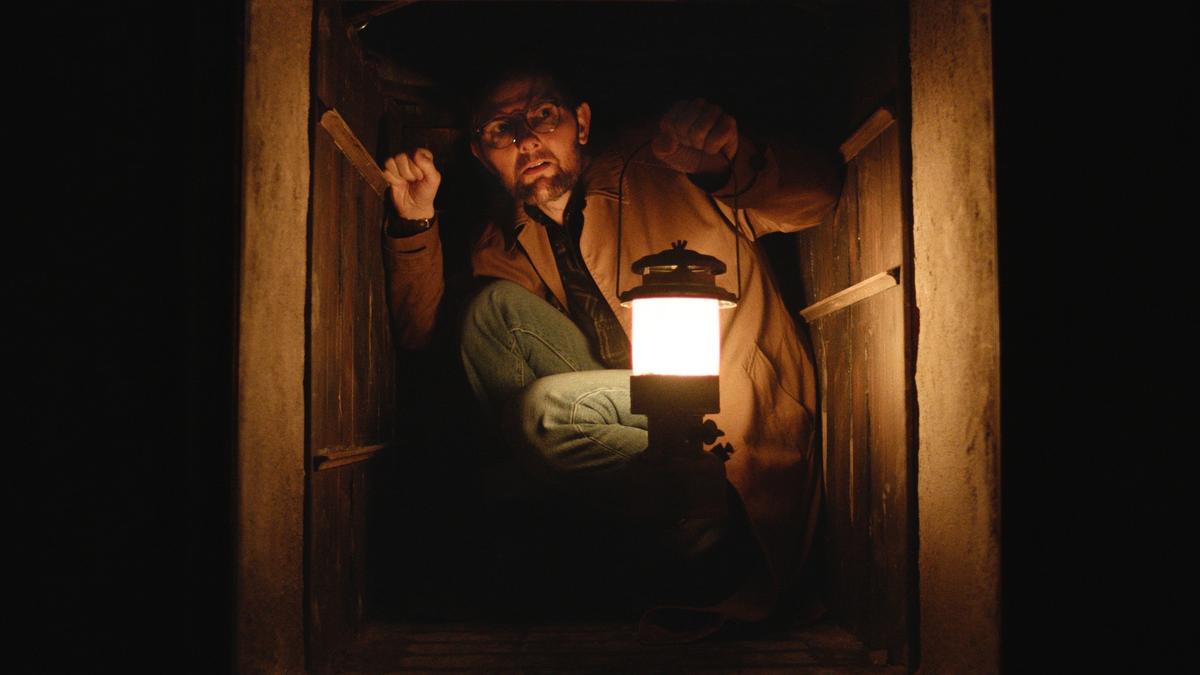
The film takes place almost entirely inside the Bilberry Woods Hotel, a fading property buried in the Irish countryside where the final few guests arrive for a Halloween celebration. At the same time, staff members quietly prepare to shut the building down for winter. Into this atmosphere walks Ohm Bauman, played by Adam Scott, an American novelist carrying two urns containing his parents’ ashes and a personality abrasive enough to make even the resident ghouls feel hospitable.
Hokum (English)
Director: Damian McCarthy
Cast: Adam Scott, Peter Coonan, David Wilmot, Florence Ordesh, Michael Patric, Will O’Connell, Brendan Conroy, Austin Amelio
Runtime: 107 minutes
Storyline: When novelist Ohm Bauman retreats to a remote inn to scatter his parents’ ashes, he’s consumed by tales of a witch that haunts the honeymoon suite
McCarthy introduces Ohm through his work. The opening sequence shows him writing the conclusion to a historical adventure novel about a conquistador stranded in the desert with a dying child, and the scene initially appears disconnected from the main story until the camera pulls back to reveal that the entire episode exists inside Ohm’s manuscript.
This intro establishes the emotional logic driving the film. Ohm writes stories where people wander toward death because he has spent most of his adult life emotionally entombed inside the loss of his parents, who died shortly after honeymooning at the same Irish hotel he now visits. McCarthy avoids turning this into a tidy psychological diagnosis and attempts to reveal the damage through behaviour — Ohm humiliates a bellhop named Alby by heating a spoon over an open flame and pressing it against the young man’s hand after Alby asks him to read an aspiring manuscript.

That ugliness becomes central to Scott’s performance. Hokum strips away the comic cushioning that often softens his cynicism, especially in his recent Severance escapades. Scott keeps Ohm emotionally rigid even as the character begins to unravel inside the hotel’s sealed honeymoon suite, and the refusal to chase sympathy lends the film a sourness that works in its favour. When Ohm eventually risks himself to search for the hotel bartender Fiona, the motivation grows from guilt and loneliness over his botched suicide attempt. Fiona disappears after warning him about the suite’s resident witch, a local legend the hotel staff accepts with weary practicality, and her absence pushes Ohm deeper into the building’s sinister secrets.
A stil from ‘Hokum’
| Photo Credit:
NEON
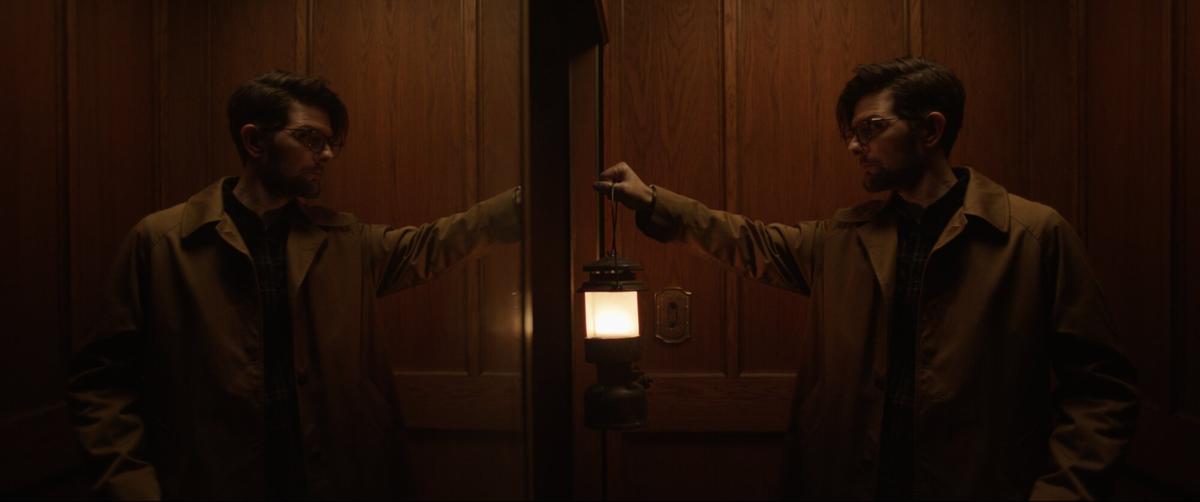
Cinematographer Colm Hogan lights the hotel with weak lamps, muddy greens, and heavy shadows that preserve spatial clarity even when characters crawl through near-total darkness. Production designer Til Frohlich fills the honeymoon suite with damp wallpaper, antique furniture, and cramped architectural dead ends that make it feel physically hostile before anything malicious even appears. McCarthy then uses sound with vicious precision, as ringing bells ring, creaking floorboards, and a mutated, uncanny-valley children’s TV program begin flooding the ominous silence.
The film loses some momentum once McCarthy begins unpacking the mystery behind Fiona’s disappearance and the crimes attached to the hotel’s past. Several supporting characters remain thinly drawn, particularly the hotel management, and the screenplay occasionally mistakes withholding information for complexity. The final stretch also leans too heavily on explanatory reveals and heightened confrontations, with the climactic encounter involving the witch pushing the film toward bluntness when the earlier sections had earned their power through suggestion alone.

Even so, Hokum succeeds because McCarthy understands the mechanical pleasures of horror filmmaking at a level many contemporary prestige directors seem embarrassed by. Though the scares land with diminishing returns this time, McCarthy still stages them with the acute understanding of just how long we will stare into a dark hallway before resenting ourselves for it. His folklore imagery still carries the grubby charm of an R.L. Stine paperback pulled from a damp school library shelf, which gives the film a pulpy nastiness that suits it well. McCarthy never fully organises many of these elements into a clean mythology. What he does create is a horror film with texture and personality, even if it barely holds up against the mastery of its predecessors.
Hokum is currently running in theatres
Published – May 17, 2026 01:00 pm IST